An agency-workflow comparison
We reviewed public client-project, workload and export documentation on 29 October 2026; this is not a delivery rehearsal or a vendor cost benchmark. LLM Citely publishes the guide and is one of the products discussed, within its stated collection scope.
Compare one client month and its deliverable
This is a public-documentation comparison, reviewed on 31 October 2026. LLM Citely publishes this page and offers a product in the category. We did not run comparative accuracy or performance tests.
| Product | Documented task | Ask to see before choosing |
|---|---|---|
| Peec AI for agencies | Isolated client projects and agency workflows | Which people can see this client and which report format is available? |
| Profound Agency Mode | Pitch and ongoing-brand environments | What continues when a pitch becomes an active client? |
| Semrush white-label reporting | Branded reports and report reuse | Which data, branding and scheduled delivery are included in the selected setup? |
| LLM Citely | Client evidence, accountable tasks and PDF/CSV delivery | Verify actual permissions, exports, shared points and platform acceptance. |
Use the same prompt, surface, market, refresh schedule, missing-data case and export requirement for each provider. A documented capability does not establish its availability in every plan or account.
Model one real client month before buying
Choose an example client with a fixed question set, named competitors and a clear reporting obligation. Specify engines, countries, frequency and the expected number of reports. Ask each vendor to quote that same workload.
Then double the client count without changing the example. This exposes whether your constraint is collection allowance, project setup, seats, reporting work or the team's review capacity.
Inspect the handoff as the client would
Request an example report and trace one statement back to the underlying answer and cited page. Check whether the report distinguishes missing data from measured absence and completed actions from observed results.
Raw exports, dashboard connectors and branded presentation files are different deliverables. Confirm the one your service actually promises and which plan provides it.
Keep narrow scope visible
LLM Citely's current build separates collection adapters under verification from integrations and model API studies still pending. Its value proposition is a reviewable workflow from approved questions to evidence, actions and client reporting.
Match a client service to the current accepted surface, not the number of logos in a roadmap. A contract requiring live observation needs per-surface acceptance; future support is not an available deliverable.
A client brief that makes quotes comparable
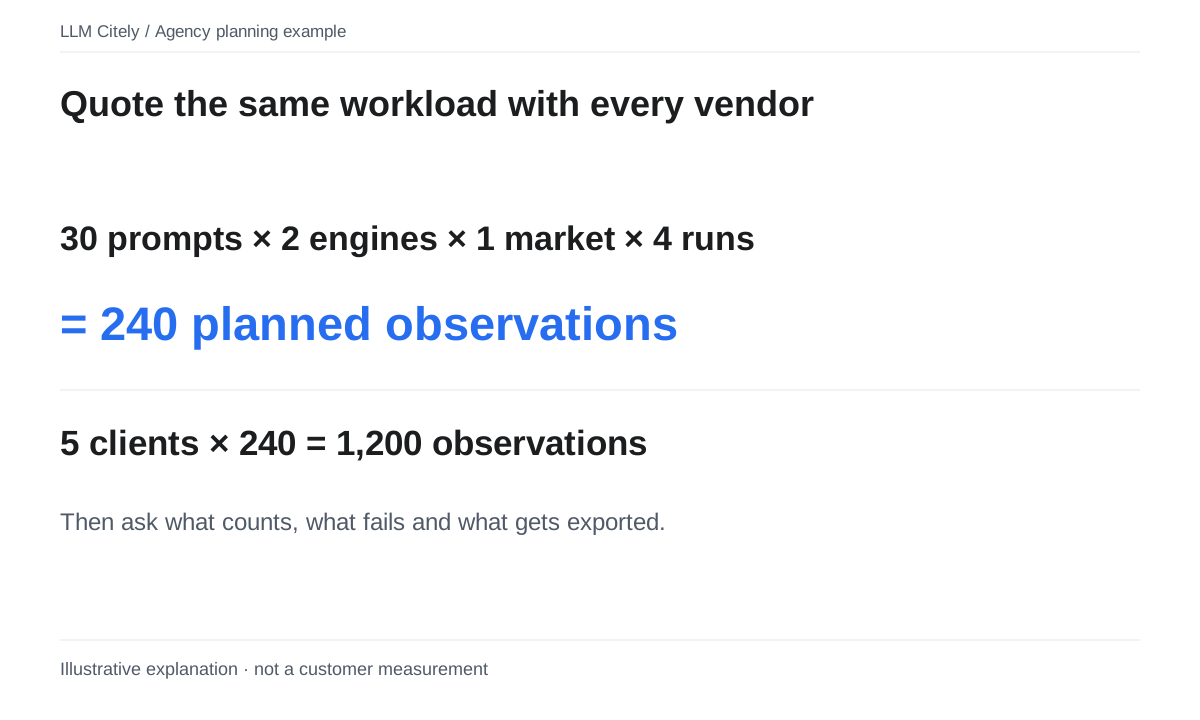
For an illustrative period, 30 buyer prompts checked on two engines in one market over four collection rounds produce 240 prompt executions. Five identical clients produce 1,200. This is a workload description, not a bill: retries, model-specific multipliers, included allowances and report preparation can change the commercial quote.
Attach the deliverable to the same brief. Does the client need a PDF, a citation file, original answers or a continuously refreshed dashboard? Those outputs are not interchangeable. Ask each vendor to price and demonstrate the same workload and handoff.
| Part of the client brief | Specify it before requesting a quote | Public-documentation checkpoint |
|---|---|---|
| Collection workload | Prompts × engines × markets × collection rounds | Ahrefs defines a base check using a prompt, model and location; confirm any platform-specific rule |
| Client setup | Separate brand, aliases, competitors and permissions | Peec documents isolated client projects |
| Pitch handoff | What becomes an ongoing project, and what expires | Profound Agency Mode describes pitch and continuing brand environments |
| Deliverable | Raw answers, citation files, presentation or connected dashboard | Otterly documents several distinct export and connector options |
| Follow-up work | Who reviews findings, owns actions and writes the report | LLM Citely's workflow shows its intended evidence-to-delivery cycle within the current scope |
What the client handoff needs to preserve
Client context: Peec AI
Peec's agency documentation describes isolated projects with their own prompts, competitors and channels, plus reporting and export options. Confirm permissions and the particular delivery format on the selected plan.
Pitch continuity: Profound
Profound Agency Mode describes pitch and continuing brand environments subject to contract limits. Ask what setup and evidence continue when a prospect becomes a client.
Raw records and report formats: OtterlyAI
Otterly's export guide distinguishes raw responses, citation files, PDFs and a plan-dependent Looker Studio connector. These solve different client-access requirements.
Workload and ownership
Ahrefs defines a base check using a prompt, model and location; confirm platform-specific rules before treating a workload calculation as a bill. For LLM Citely, inspect evidence-to-action handoff against its current platform readiness.
Make a selection you can revisit
- Define the report and evidence you promise a client.
- Build one comparable collection workload and a multi-client cost scenario.
- Walk through a pitch project, an active client and a client-facing handoff.
- Verify roles, exports, data retention, connector scope and cancellation behavior.
- Run a limited delivery rehearsal before selling a broader service commitment.
- A feature-rich agency environment may create a larger setup and process commitment than an individual consultant needs.
- An export option is not equivalent to a client portal or a fully branded live dashboard.
- An existing SEO suite may reduce operational switching, but the relevant AI allowance still needs a separate workload check.
No fixed price comparison. Ask each vendor to quote the same prompt, platform, location, frequency, client and export requirements.
A small acceptance test before a commitment
- Save the buyer task, question set, requested surface and reporting period.
- Ask the vendor to show a source-backed successful result and a failed or incomplete one.
- Open the exact answer and cited page; keep the provider's metric definitions.
- Export the deliverable you plan to use, then read it as the client would.
- Price the same workload, including quotas, model-specific units and any reporting add-on.
Record an unavailable feature as unavailable; do not infer a comparison winner from a missing public detail. Keep actual LLM Citely platform status and shared points visible.
Questions, answered.
What matters more than the number of supported engines?
For an agency, client separation, reproducible question sets, collection cost, evidence exports and reporting workload can determine whether the service is deliverable.
Does every reporting tool include white labeling?
No assumption should be made. Ask which files or dashboards can carry your branding, whether the connector is included and what clients can access.
How many prompts should an agency track?
Start with the buyer decisions in the scope of service. Expand when questions add useful coverage and the team can review the resulting evidence.
Sources and further reading
- Peec AI for agencies
- Profound Agency Mode
- Semrush AI Visibility Toolkit data sources
- Semrush Prompt Tracking
- SE Ranking AI Results Tracker
- SE Ranking AI Search add-on
- Otterly exports and reports
- LLM Citely approved product scope
- Semrush white-label reporting official documentation
This comparison uses public documentation and does not claim hands-on testing. Examples marked illustrative are not customer measurements.