Scope of this comparison
This is a public-documentation comparison of research indexes, selected-prompt tracking and source views. Source review took place on 29–31 October 2026. LLM Citely publishes this guide and offers a product in the category. We did not benchmark vendor accuracy or speed.
Compare documented workflows at a glance
| Product | Documented task | Ask to see before choosing |
|---|---|---|
| Ahrefs Brand Radar | Research-index discovery and custom prompt observation | Which dataset and campaign produced the result? |
| Semrush | Research, brand performance and prompt tracking | Which report and allowance apply to this question? |
| Peec AI | Selected-question analytics and source inspection | Can the reviewer open the answer and exact source page? |
| LLM Citely | Reviewable questions, evidence, actions and delivery | Has this surface passed acceptance and does the handoff meet the requirement? |
Use the same prompt, surface, market, refresh schedule, missing-data case and export requirement for each provider. A documented capability does not establish its availability in every plan or account.
Begin with one question your existing analytics cannot answer
Write down the decision the tool must support. Examples include choosing which buyer questions to monitor, investigating why a competitor is cited, or explaining a month of client work. A single overall visibility score cannot replace all three.
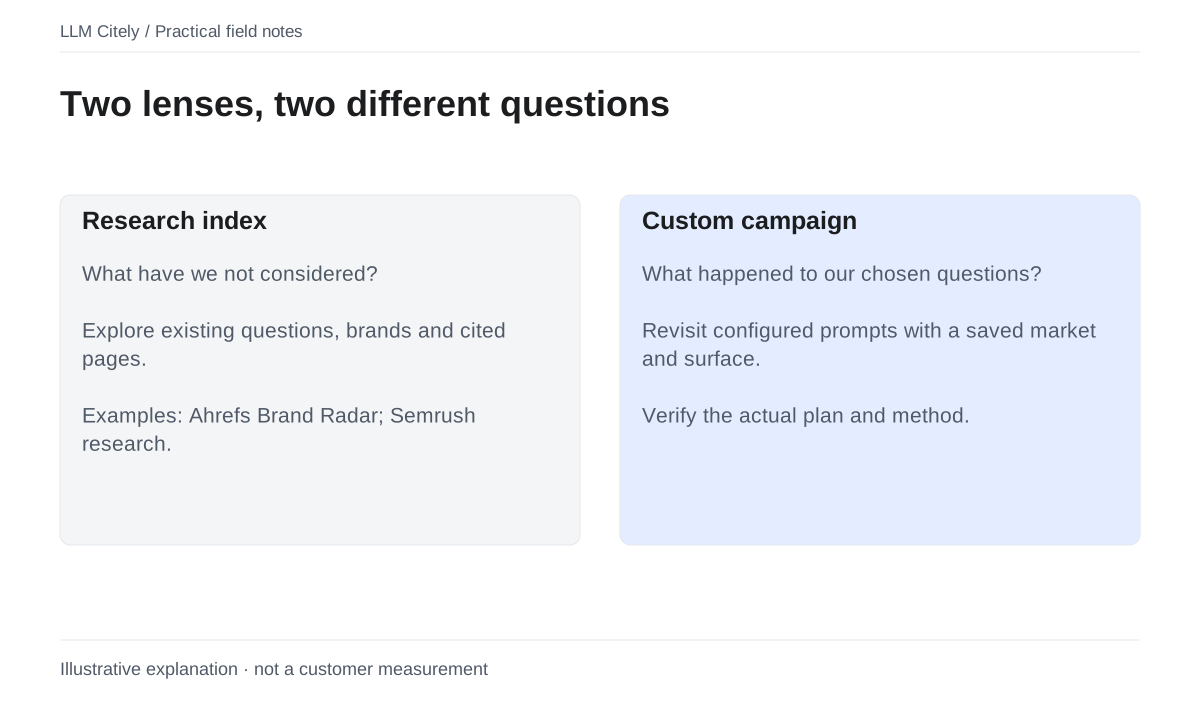
Use broad research to discover a category, and use a controlled prompt campaign when your task is a repeatable comparison. If you need both, check whether they share one quota or require separate purchases.
Compare the evidence before comparing the score
Ask each provider to walk through one brand mention and one explicit citation. Record the prompt, collection date, market, observed surface, answer and source URL. Then ask what happens when a check fails.
Treat vendor visibility scores as definitions to understand, not interchangeable measurements. Similar labels can refer to different prompt pools and denominators.
Choose the observation model before the vendor
Consider two teams. One is entering an unfamiliar market and wants to discover the questions and sources already present in a category. The other has agreed a buyer-question set with a client and needs to revisit it next month. They should not evaluate a tool using the same first test.
For discovery, inspect the research dataset. For a continuing campaign, inspect one prompt through its collection history. In both cases, ask to see the original answer and the cited page behind the summary.
| If your first question is… | Start with… | Documented examples | Check before choosing |
|---|---|---|---|
| Which topics or brands have we missed? | An existing research index | Ahrefs Brand Radar, Semrush | How questions enter the dataset and which markets it covers |
| What happened to our chosen buyer questions? | A custom prompt campaign | Semrush Prompt Tracking, Ahrefs custom prompts | Question versions, platform, location and refresh frequency |
| Which pages support an answer? | Answer and source investigation | Peec source views, Profound Answer Engine Insights | Whether a URL is an explicit citation and whether the original answer is available |
| What should we tell a client? | Evidence and report handoff | Otterly exports, LLM Citely reporting | Raw evidence, missing data and the actual report format |
Where the research and tracking models differ
Ahrefs Brand Radar
Ahrefs distinguishes its research index from custom prompts. Evaluate the index for discovery and a selected question set for repeatable observations.
Semrush
Semrush documents separate research, brand-performance and prompt-tracking data. Its custom tracking checks selected prompts for the chosen platform and location; do not treat all reports as one campaign.
Peec AI
Peec's source documentation describes URL and domain views. Use these to inspect the pages behind an answer rather than comparing only headline scores.
LLM Citely
LLM Citely's platform readiness separates adapter verification, pending integration and model API studies. Production acceptance is pending. Its selected-question workflow should be evaluated within that boundary, not as a substitute for a broad research index.
Make a selection you can revisit
- Define the brand, aliases, competitor set and buyer questions you care about.
- Separate broad discovery requirements from recurring campaign requirements.
- Inspect a source-backed result and a failed collection, not only the headline dashboard.
- Quote the same platforms, markets, frequency, history and export workload with each vendor.
- Choose the workflow you can explain and maintain, then record a baseline before changing it.
- A larger research index is useful for discovery but does not establish that it represents your specific customers.
- More engines increase coverage and collection workload; they do not automatically make every conclusion more reliable.
- Evaluate LLM Citely against the actual evidence-to-delivery task and current per-surface validation status. It should not be presented as a like-for-like replacement for a provider's broader multi-engine database.
No fixed price comparison. Ask each vendor to quote the same prompt, platform, location, frequency, client and export requirements.
A small acceptance test before a commitment
- Save the buyer task, question set, requested surface and reporting period.
- Ask the vendor to show a source-backed successful result and a failed or incomplete one.
- Open the exact answer and cited page; keep the provider's metric definitions.
- Export the deliverable you plan to use, then read it as the client would.
- Price the same workload, including quotas, model-specific units and any reporting add-on.
Record an unavailable feature as unavailable; do not infer a comparison winner from a missing public detail. Keep actual LLM Citely platform status and shared points visible.
Questions, answered.
Which AI visibility tool is the best?
The useful choice depends on whether you need category discovery, a custom question set, source investigation or client delivery. Compare those tasks explicitly instead of starting with an overall ranking.
Can I compare visibility scores from different tools?
Only after understanding their prompt populations, markets, collection surfaces and formulas. Matching labels do not make the scores equivalent.
Does this guide include hands-on accuracy testing?
No. This edition compares public documentation reviewed on 29–31 October 2026. It does not claim comparative accuracy or speed results.
Sources and further reading
- Peec understanding sources
- Profound Answer Engine Insights
- Semrush AI Visibility Toolkit data sources
- Semrush Prompt Tracking
- Ahrefs Brand Radar overview
- Ahrefs custom prompt tracking
- Otterly AI search monitoring
- SE Ranking AI Results Tracker
- SE Ranking AI Search in Competitive Research
- LLM Citely approved product scope
This comparison uses public documentation and does not claim hands-on testing. Examples marked illustrative are not customer measurements.