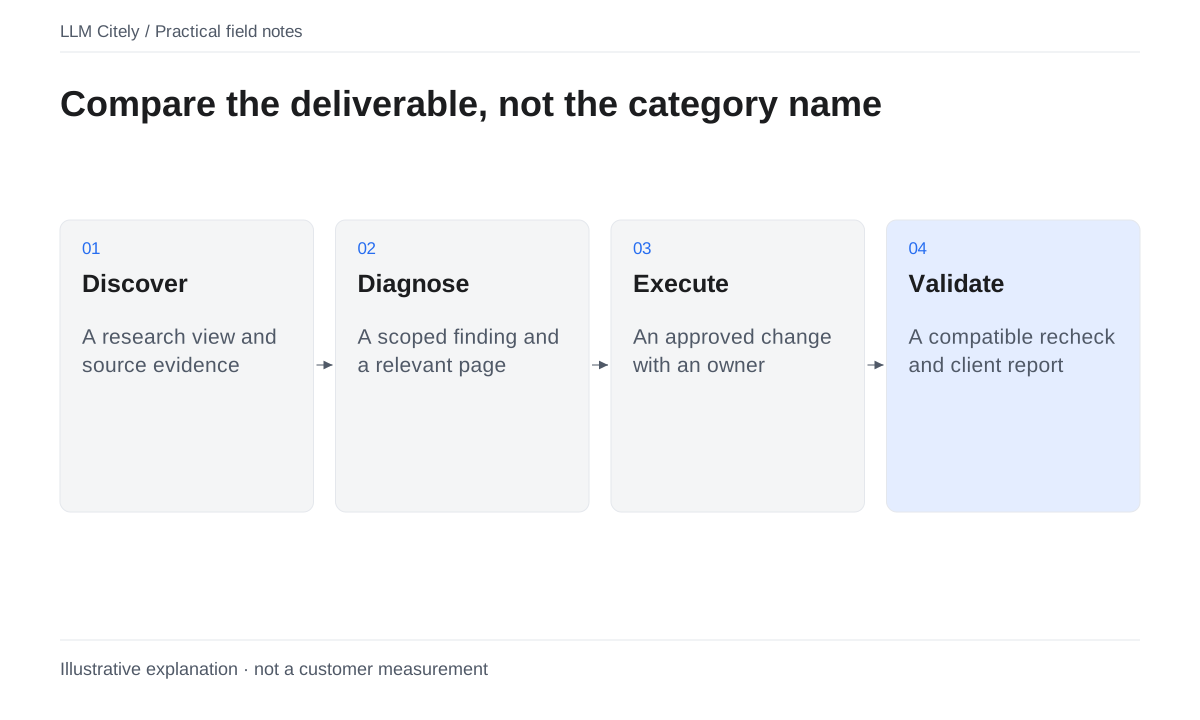
How the workflow was compared
The comparison follows artifacts described in public audit and workflow documentation, reviewed on 29 October 2026. It is published by LLM Citely, a product in this category. No comparative optimization experiment or performance benchmark was run.
Compare the audit and execution artifact
This is a public-documentation comparison, reviewed on 31 October 2026. LLM Citely publishes this page and offers a product in the category. We did not run comparative accuracy or performance tests.
| Product | Documented task | Ask to see before choosing |
|---|---|---|
| Otterly GEO Audit | A documented URL-audit workflow | One URL or a broader crawl; what was actually captured? |
| Rankscale Page Audit | Rule-based page classification and evaluation | Which finding, evidence and unavailable checks appear? |
| Profound content optimization | Content research, diagnosis and execution workflows | Which inputs, review and publishing connections are required? |
| LLM Citely | Findings, assigned work, reviewed draft and follow-up | Verify capture configuration, versioned output and actual collection readiness. |
Use the same prompt, surface, market, refresh schedule, missing-data case and export requirement for each provider. A documented capability does not establish its availability in every plan or account.
Build a workflow around a real finding
Start with one specific finding, such as a competitor-owned page appearing as an explicit source for a buyer question. Before drafting anything, inspect that answer and source. Decide whether the task concerns factual content, page access or a third-party source.
Write an acceptance condition the team can check. Examples include a corrected factual passage, a resolved page-access issue or an approved content brief. A higher AI visibility score alone is a weak task specification.
Use audits and agents for their stated jobs
An access check can identify an obstacle to retrieval; it cannot guarantee that a model will cite the page. Likewise, generating a structured draft does not prove factual accuracy or a business result.
For content workflows, inspect the input evidence, editable output and approval step. For technical tools, verify whether the report concerns one URL or a broader crawl before using it to describe the whole website.
Ask the vendor to carry one finding through the workflow
Use a small, explicit example: a buyer question produces an answer that cites a competitor's page. Open that answer, inspect the source and decide whether the next task is a page-access check, a factual correction or new content.
The handoff should leave an artifact someone can review. A diagnosis becomes a named task; a content task becomes an approved brief or change; a follow-up keeps the original question and market visible. If a product stops at one of those boundaries, decide who owns the next step.
| Stage | Output worth inspecting | Documented example | The boundary to confirm |
|---|---|---|---|
| Find the gap | The full answer and its explicit source URLs | Peec, Profound | A retrieved candidate is not automatically a citation |
| Inspect the page | A finding tied to the inspected URL or crawl | Otterly, Semrush | Otterly documents a single-URL audit; define the scope of any whole-site claim |
| Prepare a change | Editable output and a visible approval point | Profound Agents | Generating a draft is different from approving or publishing it |
| Review later evidence | A new observation with the baseline still visible | LLM Citely methodology | A later difference describes an observation; it does not prove causation |
The documented boundary of each deliverable
Page checks: Semrush and OtterlyAI
Semrush describes a separate crawl-based site audit. Otterly's GEO Audit covers crawlability, content and fan-out, and its documentation specifies a single-URL audit. Define that scope before describing a whole website.
Content execution: Profound
Profound Agents describes configurable research and content workflows with approval before publication. Inspect the editable output and approval boundary; a generated draft is not a verified result.
Client work and recheck: LLM Citely
The LLM Citely workflow connects approved questions, evidence, actions, rechecks and reports. Its current platform status remains subject to integration and production acceptance. A later answer is follow-up evidence, not proof that an action caused a change.
Make a selection you can revisit
- Map your current process into observation, diagnosis, implementation, review and recheck.
- Identify the step that is blocking actual work instead of duplicating tools across the whole process.
- Ask for one end-to-end example, including the original evidence and an unsuccessful or inconclusive follow-up.
- Check which actions are suggestions, editable drafts or actual published changes.
- Keep the baseline and report both completed work and the limits of any later comparison.
- A comprehensive workflow may need more configuration and review than a focused monitoring project.
- Automated content production increases output but does not remove factual review or publishing responsibility.
- A before-and-after observation does not establish that a particular change caused a visibility movement.
No fixed price comparison. Ask each vendor to quote the same prompt, platform, location, frequency, client and export requirements.
A small acceptance test before a commitment
- Save the buyer task, question set, requested surface and reporting period.
- Ask the vendor to show a source-backed successful result and a failed or incomplete one.
- Open the exact answer and cited page; keep the provider's metric definitions.
- Export the deliverable you plan to use, then read it as the client would.
- Price the same workload, including quotas, model-specific units and any reporting add-on.
Record an unavailable feature as unavailable; do not infer a comparison winner from a missing public detail. Keep actual LLM Citely platform status and shared points visible.
Questions, answered.
Is a GEO tool the same as an AI visibility tracker?
A tracker observes answers. A broader GEO workflow may also include page inspection, content decisions, assigned changes and later checks. Confirm each part separately.
Does passing a GEO audit guarantee citations?
No. A technical check can describe access and page signals within its inspection scope; citations depend on the question, sources and the observed answer.
Should a tool publish changes automatically?
That depends on your workflow and permission model. Review where approval occurs and what evidence reaches the publisher.
Sources and further reading
- Peec understanding sources
- Profound Answer Engine Insights
- Profound Agents
- Semrush AI Visibility Toolkit data sources
- Otterly GEO Audit
- LLM Citely approved product scope
- Rankscale Page Audit official documentation
- Profound content optimization official documentation
This comparison uses public documentation and does not claim hands-on testing. Examples marked illustrative are not customer measurements.