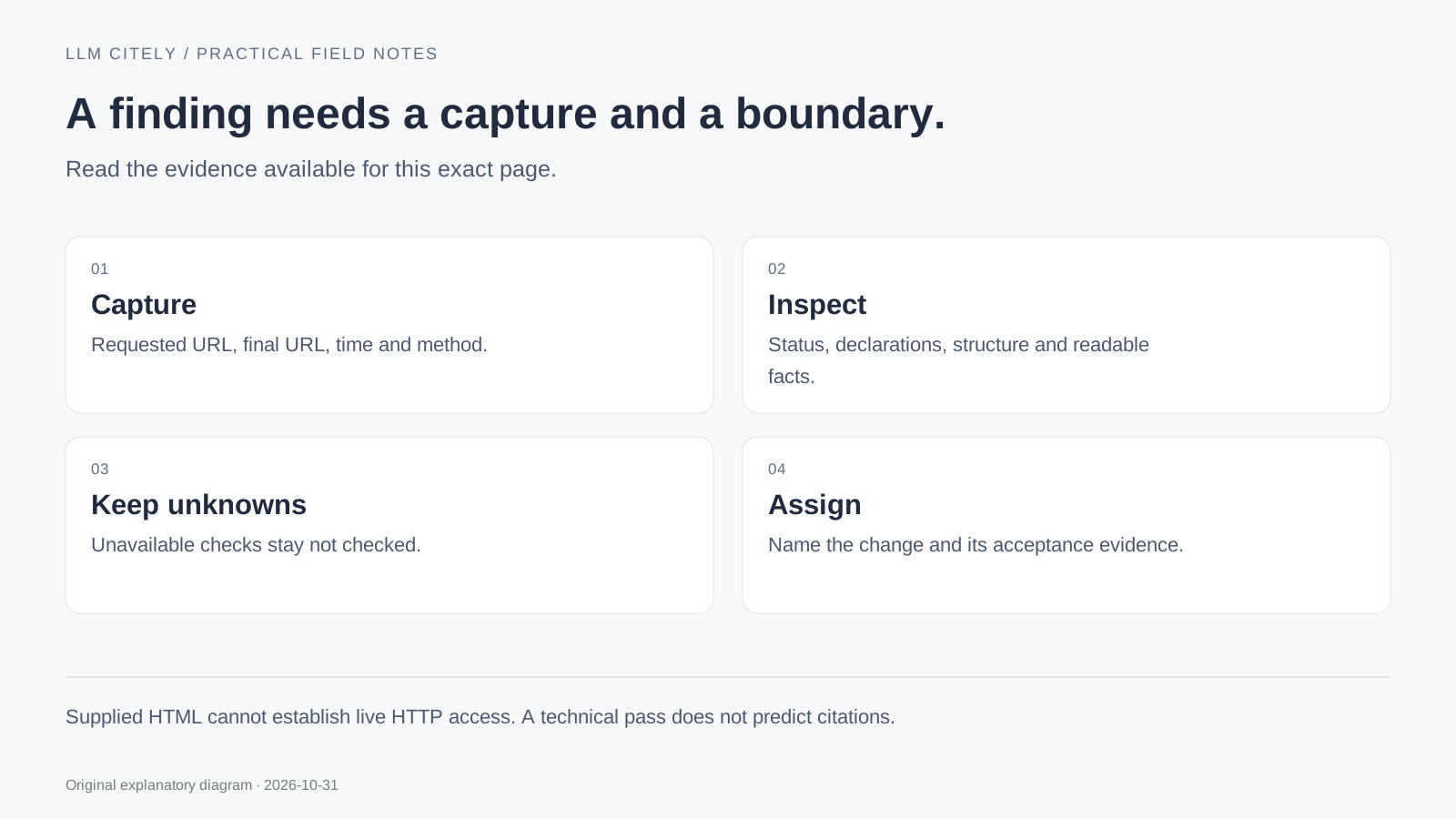
Start with the page and the capture
Pick the page that should answer a buyer's question. Record its requested URL, intended canonical URL, expected audience and the reason for inspecting it. A single-page check is a defined task; it is not evidence that every URL on the site was examined.
LLM Citely's audit workflow records findings against a captured page and its acquisition method. Review the requested and final URLs, status and capture time when they are available. If the evidence came from supplied HTML, the report must retain that scope.
The free HTML readiness checker reviews pasted source in the browser. Account-based URL audits use a configured capture route. Their availability and fees require the relevant workspace configuration; the public checker does not fetch a URL.
Look at evidence before the status label
A finding should say what was checked, what was observed and what a maintainer can do next. For example, a canonical declaration in a supplied HTML snapshot can be inspected. Whether the final deployed URL returns a redirect needs an actual HTTP observation.
| Layer | Useful evidence | Common limitation |
|---|---|---|
| Access | Final URL and response status, when captured | A pasted file cannot establish network access |
| Indexing | Served HTML directives and available headers | robots permission alone does not establish indexing |
| Structure | Title, headings, canonical and readable content | A syntactic check is not a content-quality judgement |
| Structured data | Parsed declarations and visible facts | Valid JSON is not a rich-result eligibility test |
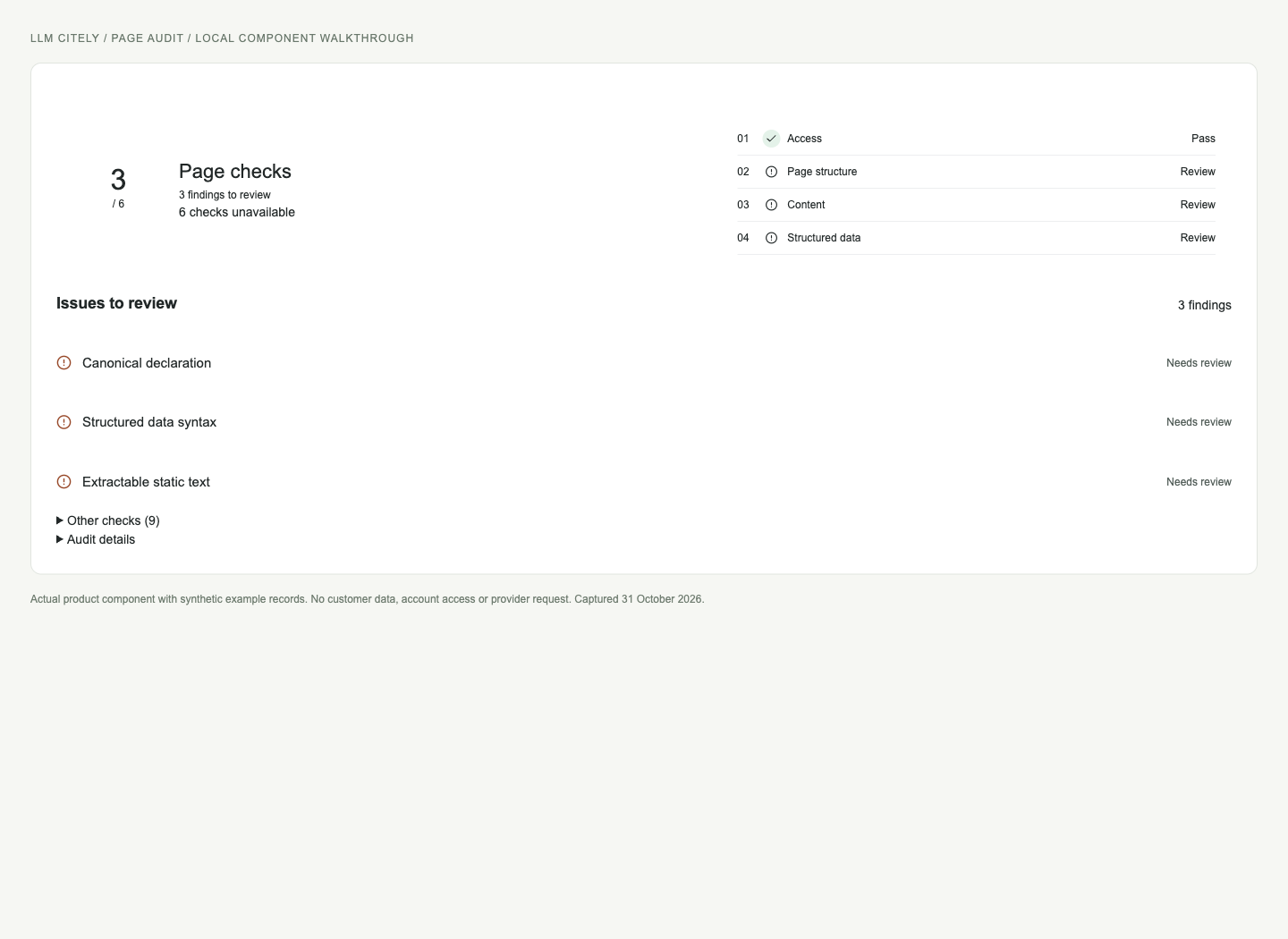
The local product screenshot below shows the actual findings component with an illustrative capture. It does not claim that a customer site or AI crawler was contacted.
Move a finding into accountable work
Choose a finding with a concrete acceptance condition. “Improve AI visibility” is too broad to verify. “Correct the canonical to the intended public URL and save the final response plus served declaration” gives the maintainer something checkable.
Add the owner, page, evidence reference, priority and recheck date in the action-plan template. A technical acceptance check can show that the page was fixed. A later AI observation is a different result and should be reported separately.
If the finding is editorial, use the content workbench to preserve the source context with the draft. Do not let a technical score become an unsupported writing instruction.
Retest the changed page, then interpret the scope
Keep the previous result, capture method and time. After the change, inspect the same target again and note whether the requested URL, served URL or observation method changed. A useful record can explain both a resolved finding and an inconclusive check.
Google's technical requirements concern crawl access, a working page and indexable content. Meeting them does not guarantee indexing or a supporting link in an AI answer. For a complete manual process, follow run a GEO audit.
Questions, answered.
Does the free checker crawl my site?
No. It reviews HTML that you paste. A configured account audit is a separate workflow with its own capture evidence.
Does a passed audit mean an assistant will cite the page?
No. The audit records the checked technical and content declarations. Citation and indexing outcomes require separate evidence.
Sources and further reading
- Google Search technical requirements
- Google: AI features and websites
- Rankscale: public description of page-audit scope
Examples marked illustrative are not customer measurements.