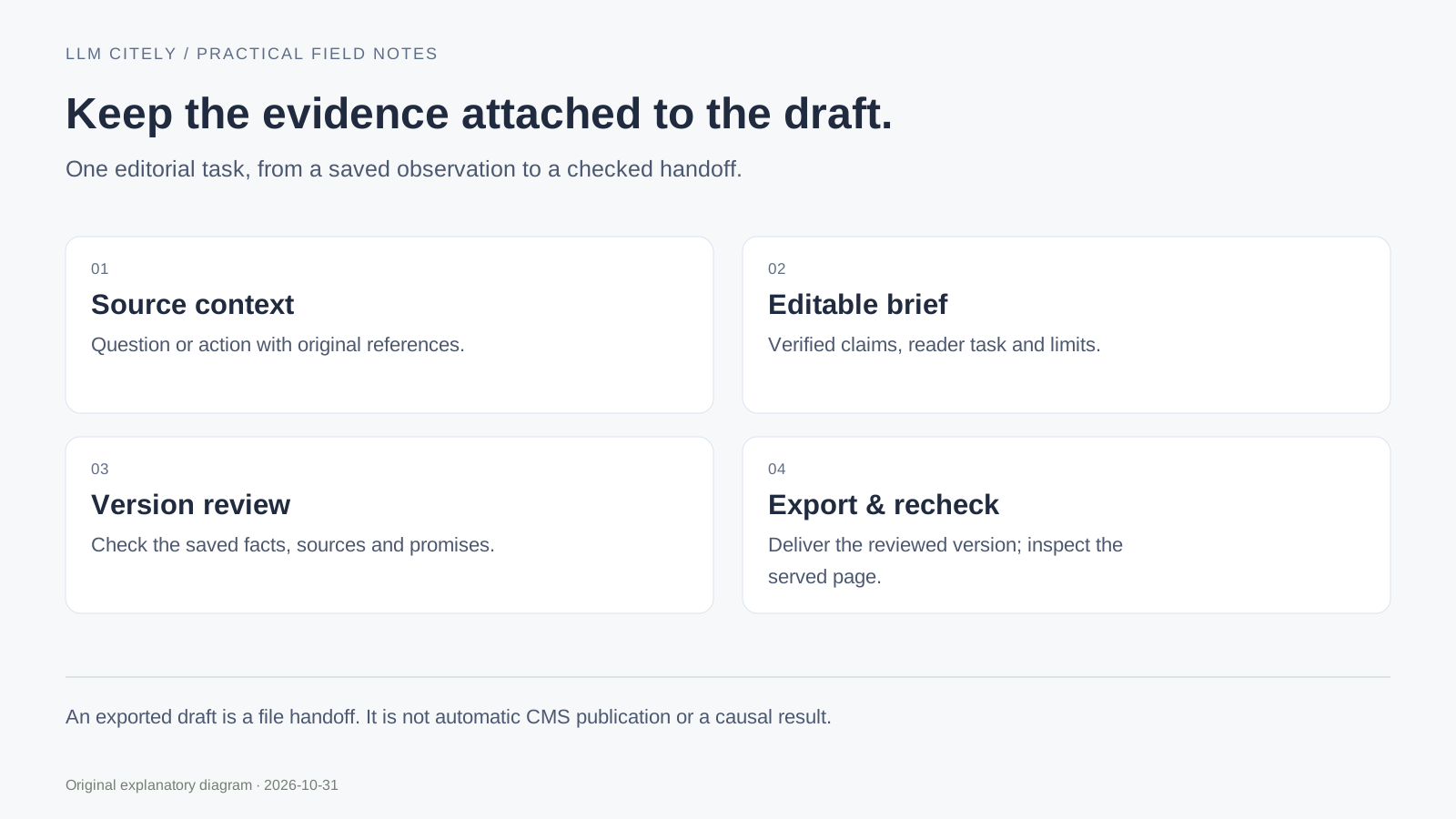
Start from a question or assigned action
An editorial task should retain the buyer question and the finding that prompted it. LLM Citely's workbench carries source context into a brief rather than presenting a blank writing box as the complete workflow.
Open the attached answer when one exists. Inspect its explicit references and verify the claims you want to use. A cited page is evidence to read, not permission to repeat every sentence in it. Missing source material should remain a fact to confirm.
Use the citation-gap walkthrough to decide whether to improve an existing page, request a correction or create a new asset before drafting.
Keep facts, gaps and instructions separate
The brief needs a reader, question, intended page and a concrete deliverable. Attach sourced facts with review notes. Keep the recorded AI observation separate from a proposed explanation of why that answer appeared.
For example, a saved answer may cite a competitor's documentation. That supports inspecting the documentation. It does not prove that adding a longer comparison table will change the next answer. The writer should know which facts are verified and which claims are out of scope.
The editable content-brief template can be used before a project is configured. It produces a Markdown handoff locally, without generating prose or contacting an assistant.
Review the saved version you plan to deliver
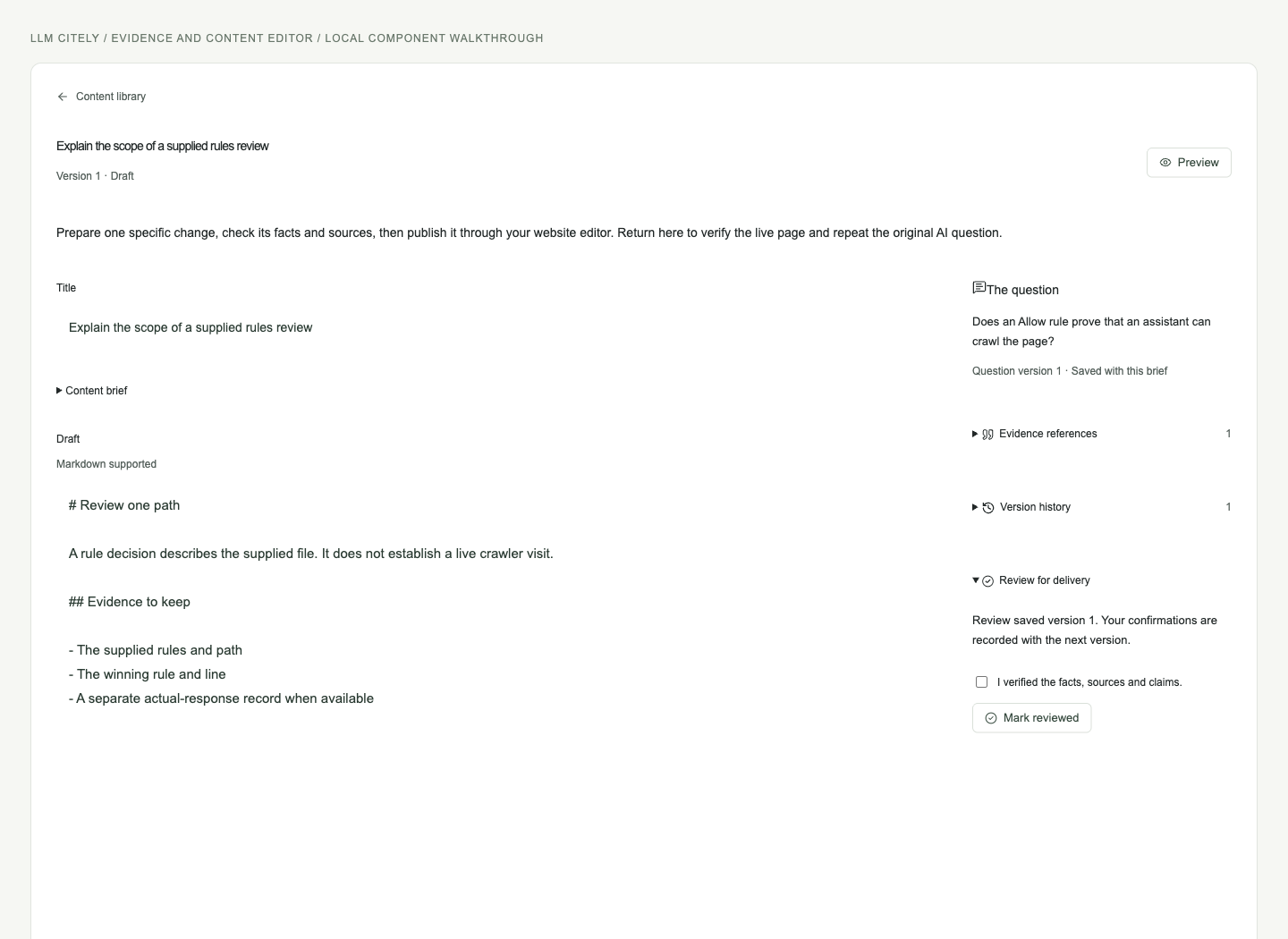
The editor keeps the title, brief, Markdown body, evidence references and version history in one view. If generation is configured, a suggested draft still needs review. Your newer edits should remain available when an older operation completes or a save conflicts.
Check the facts, source interpretation and product promises before marking a saved version reviewed. Editing after review creates a new draft; the reviewed export should identify the version it actually contains.
The screenshot below is captured from the actual local editor component using an explicitly synthetic brief. It demonstrates fields and review state, not a customer outcome or a production AI generation.
Deliver a reviewed artifact
A reviewed version can be exported in the formats available in the editor. Verify the file before sharing it: headings should read correctly, source URLs should resolve as intended, and placeholder facts should have been removed or clearly qualified.
Exporting HTML or Markdown is a file handoff. It is not a native connection to a CMS, automatic publication or an outreach email. The publisher still owns the final approval and the served page.
Keep the implementation task and acceptance evidence in the action plan. The client report explains completed work and remaining uncertainty.
Use later answers as follow-up evidence
After publication, review the served page and save what changed. Then collect a comparable observation only when the required collection surface is available and the question set is approved.
Preserve the original wording, aliases, market, surface and time range. If any of them changes, describe a new cohort. A new citation can be useful evidence, but the sequence of publication and a later answer does not establish causation.
For the broader editorial process, read AI search optimization. Public descriptions from Profound and Peec also show that evidence-to-action workflows are an existing product category; evaluate the actual handoff each tool supplies.
Questions, answered.
Does the workbench publish to a CMS?
The documented workflow here is editing, review and file export. Do not assume a native publishing connection.
Does a generated draft count as verified evidence?
No. The reviewer still needs to verify facts, references and claims before delivering a saved version.
Sources and further reading
- Profound: public content-optimization workflow
- Peec Agent: public workflow description
- Google: helpful, reliable content
Examples marked illustrative are not customer measurements.