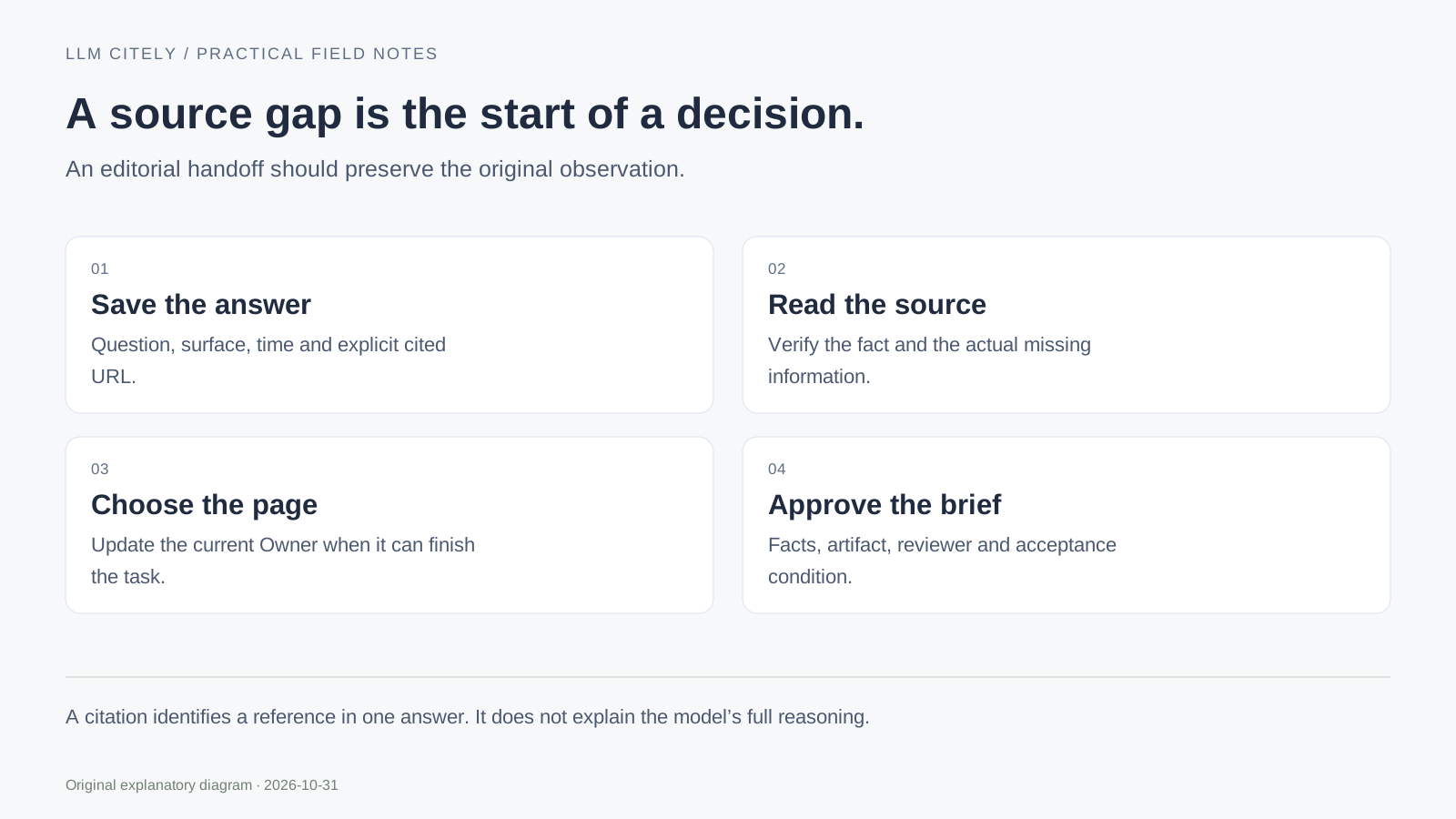
Keep the exact answer before planning content
Start with a saved answer that contains an explicit source link worth investigating. Preserve the buyer question, wording version, surface, requested market, collection time and complete answer. A source domain without the cited page can hide the context that matters.
Our worked example is illustrative: a buyer asks whether an analytics product can export a reviewable evidence file. The answer links to a competitor's export documentation, while the target brand's relevant page does not explain its file fields.
This observation supports inspecting both pages. It does not prove that the assistant prefers the competitor because of one table, or that a new article will change the next answer. Use find AI citation gaps if you still need to establish the diagnosis.
Read the pages, then name the missing information
Open the cited page and your intended page. Separate an actual missing fact from a merely different writing style. Verify the current product behavior with its owner before asking an editor to add a promise.
For the example, the useful question is whether an export contains the question, observation time and explicit source URLs. The writer needs verified fields and limits. “Competitors have more authority” is not a sufficiently specific brief.
Attach the source, date and reviewer to each product claim. If a limit is unknown, leave it as a fact to confirm. A generated paragraph or an AI answer repeating that claim is not independent confirmation.
Choose an existing page before opening another URL
Ask where a reader should finish the task. If the feature or documentation page already explains exports, a focused update there may be enough. A separate tutorial makes sense only when the reader needs a different operation, output or explanation.
| Decision | Example action | Avoid |
|---|---|---|
| Existing page can answer the task | Add the verified export-field table and sample file | Another near-identical export feature page |
| Reader needs operating steps | Create a specific how-to with actual steps and result | A definition article with no usable instructions |
| Fact belongs in a third-party source | Assign a verification or correction request | Pretending an owned article changes that source |
Keep the selected Page Owner in the brief. This is how a citation investigation can improve topical coverage without creating keyword duplicates.
Give the editor the evidence and acceptance condition
Use the editable brief to capture the question, reader, page, verified facts, observed gap, required artifact and limits. The content workbench keeps an account draft connected to its saved source context.
For the example, require a small export-field table and a downloadable file that the reviewer can open. Add a screenshot near the steps it explains. Label fictional sample rows clearly and avoid client or provider credentials.
An acceptance condition can be concrete: the product owner confirms the fields, the editor checks the claims and source links, and a reviewer opens the served page and file. “Increase citations” cannot replace those checks.
Separate editorial acceptance from a later observation
Review a saved version, export it and inspect the final served page after publication. Preserve the version and what actually changed. The action plan can track this work independently of the next monitoring result.
If collection is available, repeat the approved question with the same context and report sample coverage. Record a different question set or collection method as a changed baseline. A new source link is a later observation, not proof that the edit caused it.
The measurement walkthrough explains the denominator checks. The report should be able to show useful completed work even when the follow-up is missing or inconclusive.
Questions, answered.
Should every missing citation create a new page?
No. Improve the existing page when it can complete the same task. A new URL needs a distinct user task and deliverable.
Does a citation tell me exactly why the model chose a source?
No. It identifies a referenced source in that observation. Explanations of model behavior still need evidence and qualification.
Sources and further reading
- Peec: URL and domain source views
- Profound: public content-optimization workflow
- Google: original, useful information and clear sourcing
Examples marked illustrative are not customer measurements.