Write a baseline someone else can repeat
Use a short scope statement before collecting answers. For this illustrative worksheet it is: “Twelve approved buyer questions about analytics for small SaaS teams; United States; English; the ChatGPT website search experience; one attempt per question; Northstar as the target brand; Example B and Example C as the comparison set.”
Add the question version, collection time and matching rules to that statement. “Northstar” in a sentence counts as a target mention; a citation link to an owned domain is classified separately. A different model API or a question rewritten halfway through collection belongs in a separately labeled cohort.
The buyer-question guide shows how to assemble the question list. LLM Citely’s methodology explains the observation and comparison boundaries.
Start with the twelve-row worksheet
Illustrative worksheet. Northstar, Example B and Example C are fictional brands. The rows below were constructed to explain the calculation; they are not ChatGPT test results.
| Run | Outcome | Northstar in answer text | Example B | Example C | Citation evidence complete? | Owned URL explicitly cited? |
|---|---|---|---|---|---|---|
| Q01 | Valid | Yes | Yes | No | Yes | Yes |
| Q02 | Valid | Yes | No | No | Yes | Yes |
| Q03 | Valid | No | Yes | No | Yes | No |
| Q04 | Valid | Yes | No | Yes | Yes | No |
| Q05 | Valid | Yes | Yes | No | Yes | No |
| Q06 | Valid | No | No | Yes | Yes | No |
| Q07 | Valid | No | No | No | Yes | Yes |
| Q08 | Valid | Yes | Yes | No | Yes | No |
| Q09 | Valid | Yes | No | No | No | Unknown |
| Q10 | Valid | No | No | No | No | Unknown |
| Q11 | Failed | Unknown | Unknown | Unknown | No | Unknown |
| Q12 | Pending | Unknown | Unknown | Unknown | No | Unknown |
Ten rows have readable, in-scope answers. Q11 failed and Q12 has not produced an answer, so both stay outside the answer-based calculations.
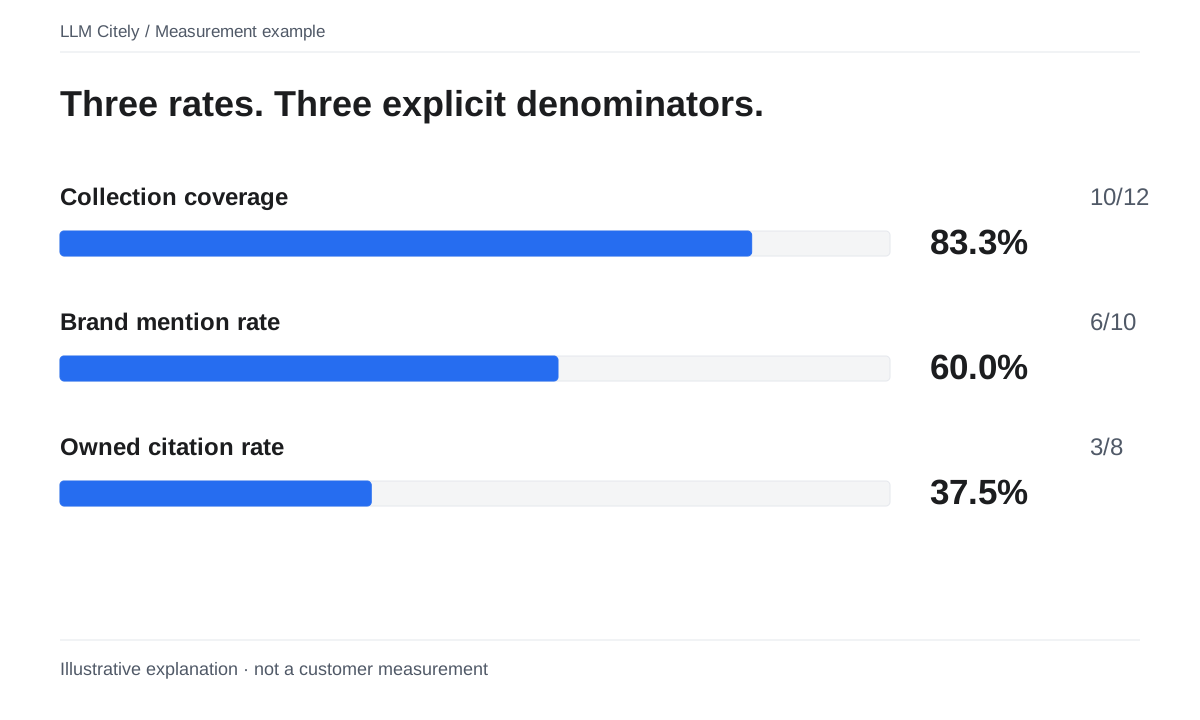
Collection coverage = valid answers / planned runs
                    = 10 / 12
                    = 83.3%
A coverage figure tells a client how much of the planned work produced usable evidence. It does not tell them whether the brand appeared.
Count six mentioned answers, not name repetitions
Northstar appears in Q01, Q02, Q04, Q05, Q08 and Q09. That is six of the ten valid answers.
Mention rate = valid answers containing Northstar / valid answers
             = 6 / 10
             = 60%
If Q01 says “Northstar” three times, it still contributes one mentioned answer. If Q11 failed, it contributes neither a positive nor a negative answer. Q09 can contribute to this metric because its answer text is readable even though its citation evidence is incomplete.
AI share of voice uses another denominator: appearances across the tracked brand set.
Use eight citation-eligible answers for the citation rate
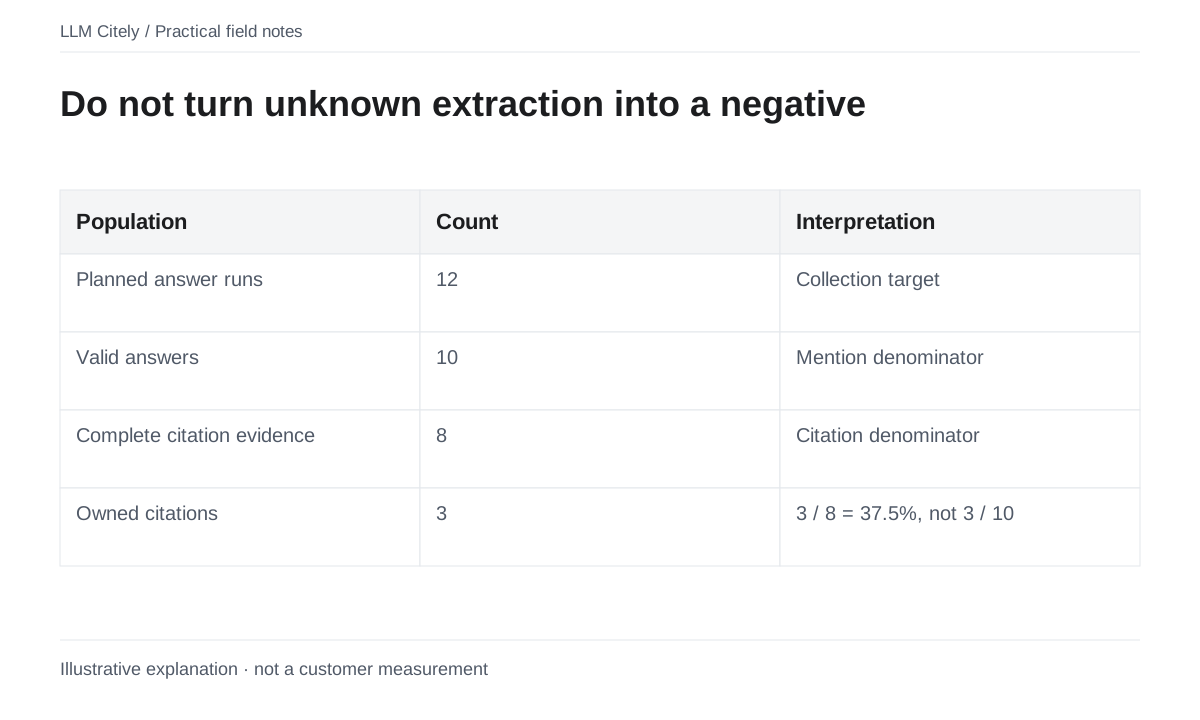
Q01–Q08 have complete citation evidence. Three of them—Q01, Q02 and Q07—explicitly cite an approved Northstar URL.
Owned citation rate = answers with an owned citation / citation-eligible answers
                    = 3 / 8
                    = 37.5%
“Complete” can include a verified empty citation list. Q05 and Q08 are valid negative observations because their complete lists contain no owned citation. Q09 and Q10 have incomplete lists, so their owned-citation status is unknown. Treating them as negatives would produce 3/10 = 30%, which changes the question and hides the extraction gap.
Q07 has an owned citation without a target-name mention in its answer text. Mentions and citations are independent observations.
Compare the same questions before comparing percentages
Before a second collection, check four items:
| Comparison item | Compatible | Needs a separate cohort |
|---|---|---|
| Question | Same ID, wording and version | A new audience or constraint |
| Observation | Same engine, surface and market | Website answer replaced by API output |
| Matching | Same brand identity and aliases | Broader alias rule |
| Metric | Same evidence eligibility rule | Unknown citations changed to zero |
If two questions change, compare the unchanged subset or start a new baseline. Explain that choice beside the sample count. A later difference shows what was observed; assigning that difference to a page edit requires more evidence.
Give the client this five-line summary
The illustrative worksheet supports this summary:
| Measure | Numerator and denominator | Result |
|---|---|---|
| Collection coverage | 10 valid / 12 planned | 83.3% |
| Target mention rate | 6 mentioned / 10 valid | 60% |
| Owned citation rate | 3 owned-cited / 8 citation-eligible | 37.5% |
| Sampled brand SOV | 6 target appearances / 12 tracked-brand appearances | 50% |
| Unresolved work | Q11 failed; Q12 pending; citations incomplete for Q09–Q10 | Visible beside the figures |
Use the report template for the narrative and the AI visibility feature to inspect the evidence behind a result. OpenAI’s source guidance explains how a reader can open cited pages; our worksheet adds an explicit eligibility rule for counting them.
Questions, answered.
What is a good AI visibility score?
There is no universal score across tools or question sets. Establish a relevant baseline, inspect coverage and compare consistent samples before setting an improvement target.
Can a zero mention rate mean the brand is invisible everywhere?
No. It means no qualifying brand match was found in the eligible sample. Check scope, aliases, failed runs and the selected questions.
Does improvement prove the content changes worked?
A before-and-after observation shows a difference. Attribution requires additional evidence because question mix, platform behavior and collection conditions can also change.
Sources and further reading
Examples marked illustrative are not customer measurements.