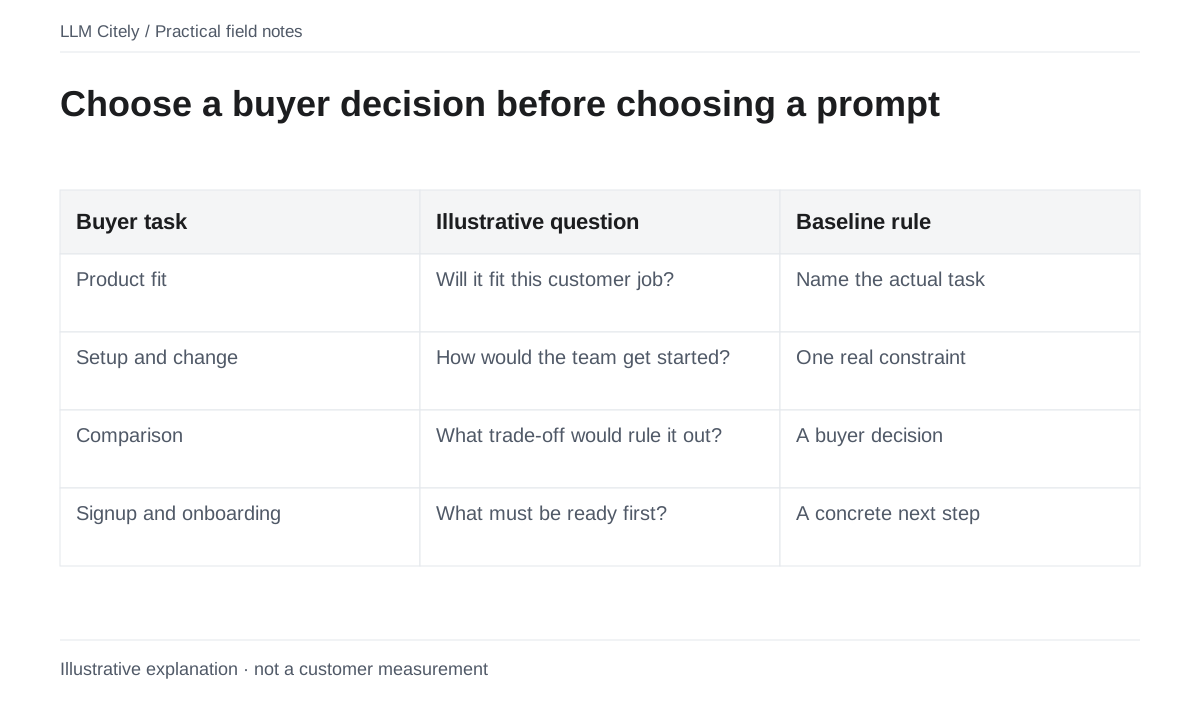
Bring one piece of customer language to each question
For our fictional Northstar analytics exercise, imagine a sales note that says: “We have two growth people and no data engineer; setup effort matters more than another chart.”
That note supports a specific question: “Which analytics tools suit a SaaS team without a data engineer?” It does not support an invented monthly ChatGPT search volume.
| Input | What it contributes |
|---|---|
| Customer interview or sales note | The buyer’s wording and constraints |
| Support ticket | A task or implementation failure |
| Product documentation | Facts the product can substantiate |
| Generated suggestion | A hypothesis to review |
A proposed question should identify its input type. Use the generator to draft questions, then approve the ones that fit the task.
Fill four task groups before adding more synonyms
This is one illustrative twelve-question plan for a small-team analytics brand. It is a planning exercise, not measured demand.
| Task group | Question IDs | What the buyer needs to decide |
|---|---|---|
| Product fit | Q01, Q05, Q08, Q12 | Whether a small team can use the product for its needs |
| Setup and change | Q02, Q07, Q10 | How to get started or change an existing setup |
| Comparison and trade-offs | Q03, Q06, Q11 | Which criteria, limits and data trade-offs matter |
| Signup and onboarding analysis | Q04, Q09 | How to investigate a concrete funnel problem |
For example, Q01 asks about operating without a data engineer; Q08 asks about cohort reports. They can be separate tasks even though both concern product fit. Four rewrites of “best analytics tools” do not provide the same coverage.
Here is the complete question wording for this fictional teaching set. These are constructed examples, not logged buyer demand or a live experiment. The IDs carry the same meaning in the measurement and citation walkthroughs.
| ID | Buyer task | Question text in this illustrative baseline |
|---|---|---|
| Q01 | Select a shortlist without a data engineer | Which analytics tools suit a SaaS team without a data engineer? |
| Q02 | Prepare a first analytics installation | What should a small SaaS team define before installing a product analytics tool? |
| Q03 | Compare cohort-analysis capabilities | How should a small SaaS team compare cohort-analysis features across analytics tools? |
| Q04 | Investigate signup drop-off | Which analytics tools let a small team investigate signup drop-off? |
| Q05 | Evaluate pricing against event growth | Which analytics tools have pricing a small SaaS team can predict as event volume grows? |
| Q06 | Compare hosting responsibilities | What should a small SaaS team compare when choosing hosted versus self-hosted product analytics? |
| Q07 | Find funnel-event implementation guidance | Where can a small SaaS team find a clear guide to setting up funnel events? |
| Q08 | Find a tool for cohort reports | Which analytics tools help a small SaaS team build and review cohort reports? |
| Q09 | Separate instrumentation failure from an onboarding problem | How can a small SaaS team tell whether a signup drop-off is a tracking error or a real onboarding problem? |
| Q10 | Plan an analytics migration | How can a small SaaS team move to a new analytics tool without losing the meaning of existing funnel events? |
| Q11 | Compare data-retention and deletion conditions | Which data-retention and deletion limits should a small SaaS team compare before choosing analytics software? |
| Q12 | Find an appropriate weekly reporting workflow | Which analytics tools let a small SaaS team share a readable weekly product report? |
Put brand verification in a different cohort
Compare these two questions:
| Question | What its answer can help evaluate |
|---|---|
| “Which analytics tools suit a SaaS team without a data engineer?” | Whether a brand appears in an unbranded shortlist |
| “Is Northstar suitable for a SaaS team without a data engineer?” | How the assistant describes a named brand |
The second question puts the name into the conversation. Labeling its answer as an unprompted discovery win would overstate what was tested.
The twelve-question worksheet used across these guides is the unbranded cohort. Branded verification can be useful, but it gets its own IDs and report rather than changing that worksheet’s denominator.
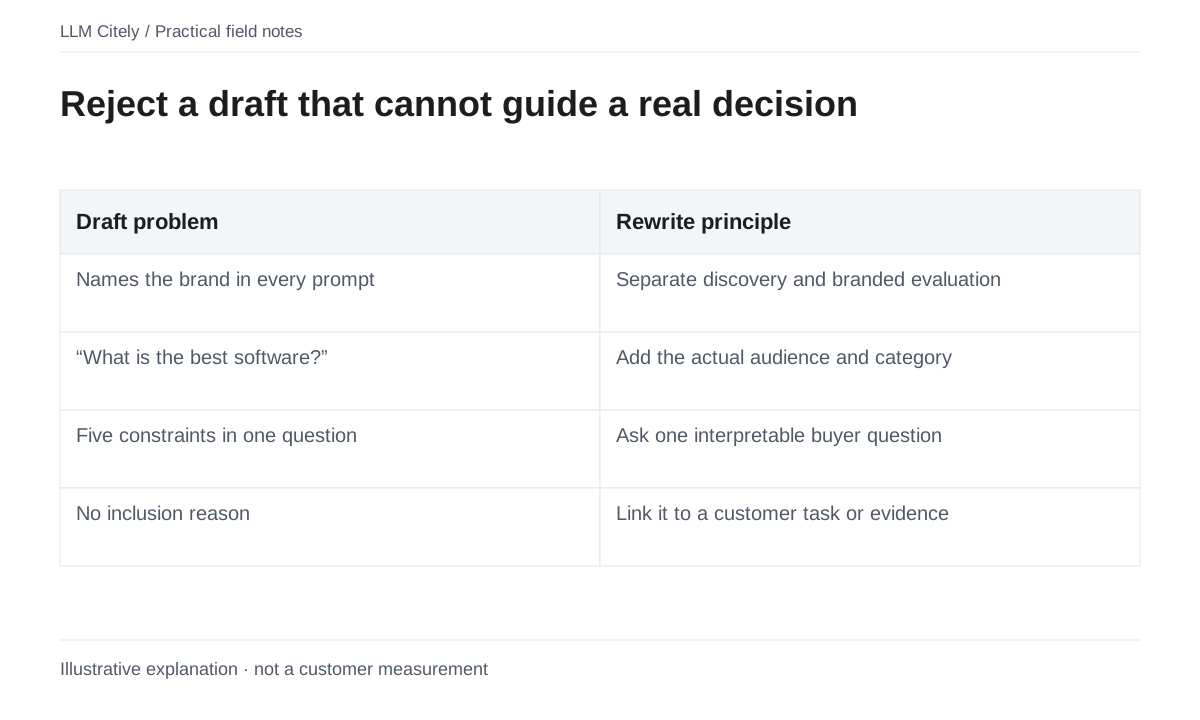
Reject questions that fail a three-part review
Use these criteria before approving a suggestion:
| Review | Pass condition | Reject or revise when |
|---|---|---|
| Buyer relevance | A real target buyer could ask it | It targets a different audience |
| Product fit | The business can substantiate a useful answer | It depends on an unverified feature |
| Useful response | A changed answer could guide a specific review or task | No one knows what to do with the result |
For the fictional example, “Which analytics tool predicts enterprise revenue automatically?” should not enter the set merely because a generator wrote it. First verify that the claimed capability and target audience belong to the business.
In Google’s explanation of AI search, one user question can lead to related searches. That mechanism is context for research, not evidence that a generated question has known demand.
Make the first collection small enough to review
Use a short approval worksheet:
| ID | Candidate | Basis | Proposed action if the answer reveals a gap |
|---|---|---|---|
| Q01 | Tools for a team without a data engineer | Illustrative sales note | Review the setup explanation |
| Q04 | Tools for investigating signup drop-off | Illustrative buyer task | Inspect relevant funnel guidance |
| Q07 | A guide to setting up funnel events | Illustrative implementation task | Check whether a useful owned guide exists |
These three candidates have different outputs to inspect. Approving them does not guarantee any particular brand will be mentioned or cited.
A manageable first set leaves time to read the answers. Question tracking can organize the approved wording, topic and intent; the reviewer remains responsible for its fit.
Freeze the wording before you measure it
Merge “best analytics tools for a small SaaS team” with a superficial rewrite if both ask the same test. Preserve a separate question when its operating constraint changes the task, such as requiring a team without a data engineer.
For the constructed twelve-run example, collection later produces ten valid answers. That gives 83.3% coverage; six target-mentioned answers give 60% mention rate. Eight citation-complete answers and three owned citations give 37.5%, so question coverage and citation completeness need separate fields.
Save the approved wording and version before comparing periods. The ChatGPT tracking walkthrough shows collection, and the measurement guide shows how missing evidence changes eligibility.
Questions, answered.
How many prompts should a brand track?
Start with a set the team can review and act on. Expand when the chosen decisions, scope and evidence can be maintained; there is no universal count that makes a sample representative.
Are generated prompts real customer searches?
No. They are proposed questions. Label the source and validate them against customer language and the intended buying task.
Can Google keyword volume be used as ChatGPT prompt volume?
No. They describe different populations. Keep a keyword estimate as a contextual signal and mark exact AI-question demand unknown unless you have appropriate evidence.
Sources and further reading
Examples marked illustrative are not customer measurements.