Resolve the brand name before the first question
Our fictional client is Northstar, an analytics product for small SaaS teams. Its approved owned domain is northstar.example; that reserved example address is not a live customer website.
| Candidate match | Decision in this exercise |
|---|---|
| “Northstar” in the small-team analytics context | Target-name mention |
| An unrelated business sharing the name | No match |
| Repeated “Northstar” in the same answer | One mentioned answer |
| An explicit link to northstar.example/help, with no name in the answer text | Owned citation; no textual mention |
Approve ambiguous cases with the client before calculating a percentage. The mentions-and-citations guide explains why the final row matters.
Ask questions that do not supply the answer
Begin with questions a buyer could ask before knowing the brand. These are illustrative candidates, not observed search demand:
| ID | Buyer task | Question |
|---|---|---|
| Q01 | Select a shortlist | Which analytics tools suit a SaaS team without a data engineer? |
| Q04 | Investigate a problem | Which analytics tools let a small team investigate signup drop-off? |
| Q07 | Find implementation help | Where can a small SaaS team find a clear guide to setting up funnel events? |
A separate question such as “Does Northstar support cohort analysis?” checks brand facts because it supplies the brand name. Tag it as branded verification and report that cohort separately from discovery questions.
Expand the set with the buyer-prompt worksheet or the prompt generator.
Collect the answer and the context together
For a manual check, use ChatGPT’s Search mode when available, submit the approved question and save the readable answer. Open visible citations and capture their actual destinations. OpenAI documents the Search and Sources controls.
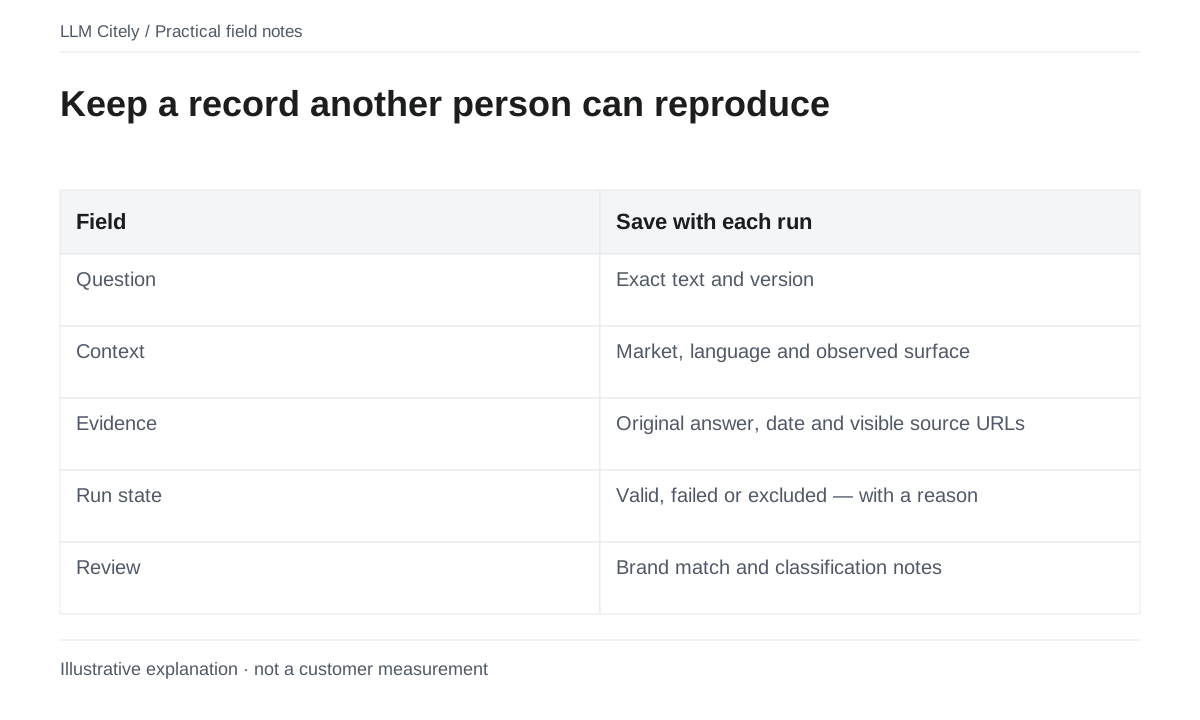
Attach the exact question/version, time, observed product surface, requested market, available location context and run outcome to the saved answer. If the location cannot be established, mark that limitation. A requested “US” question does not itself prove which location the product used.
For collection through a service, check the supported observation surface and preserve its provider/method label. A website search answer and a model API response are separate observations.
Review a single answer three ways
Consider this constructed Q04 example:
Northstar and Example C are options to compare for signup analysis. Review the retention criteria in this comparison [1].
The explicit reference [1] points to review.example/analytics-criteria. A source panel also lists northstar.example/docs as another relevant page.
The classifications are:
- Target mention: yes, because the answer text names the fictional target.
- Owned citation: no, because the explicit reference goes to a third party.
- Retrieved owned page: present in the source panel; it does not establish an owned citation.
If the citation list was only partly extracted, the owned-citation result would instead be unknown. Use the saved answer as the review artifact rather than classifying from an aggregate dashboard number.
Calculate the example without hiding missing evidence
Our complete constructed worksheet plans twelve runs. Ten yield valid answers, six of those mention Northstar, eight have complete citation evidence and three explicitly cite an owned URL.
| Result | Calculation |
|---|---|
| Collection coverage | 10/12 = 83.3% |
| Target mention rate | 6/10 = 60% |
| Owned citation rate | 3/8 = 37.5% |
Q11 failed and Q12 is pending. Q09 and Q10 have readable answer text but incomplete citation evidence. Those are four different states to resolve, not four answers to label “brand absent.”
The full calculation guide provides all twelve rows.
Turn the next review into a specific decision
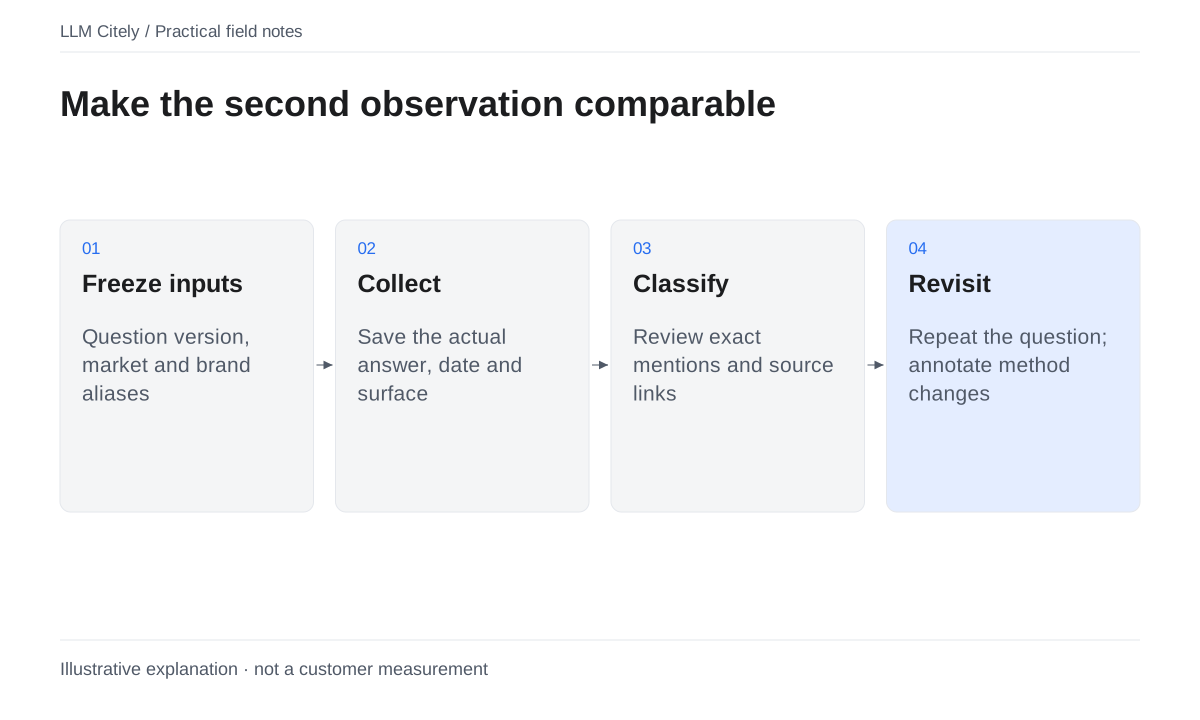
Repeat the approved question versions under comparable conditions. If a question, brand alias or observation surface changes, label the change before comparing the results.
Choose the follow-up from the evidence: a wrong product fact needs a factual correction; an incomplete citation list needs another evidence review; an appropriate owned page absent from a complete list needs an investigation of that question and source context.
The scoped answer checker explains its current collection boundary, and AI visibility tracking connects saved answers to later reviews. Neither a single answer nor a favorable second run establishes a market-wide position or proves that a particular edit caused the change.
Questions, answered.
Does checking once show my normal ChatGPT position?
A single answer is one observation. Keep its context and repeat comparable questions before describing a pattern.
Can I use an API answer as a ChatGPT web measurement?
Record it as an API observation. Do not relabel it as the consumer website experience or compare the surfaces without explaining the difference.
What should I do if the brand does not appear?
Check run eligibility, aliases and question relevance first. Then inspect actual cited material and the accuracy and accessibility of the relevant pages.
Sources and further reading
Examples marked illustrative are not customer measurements.