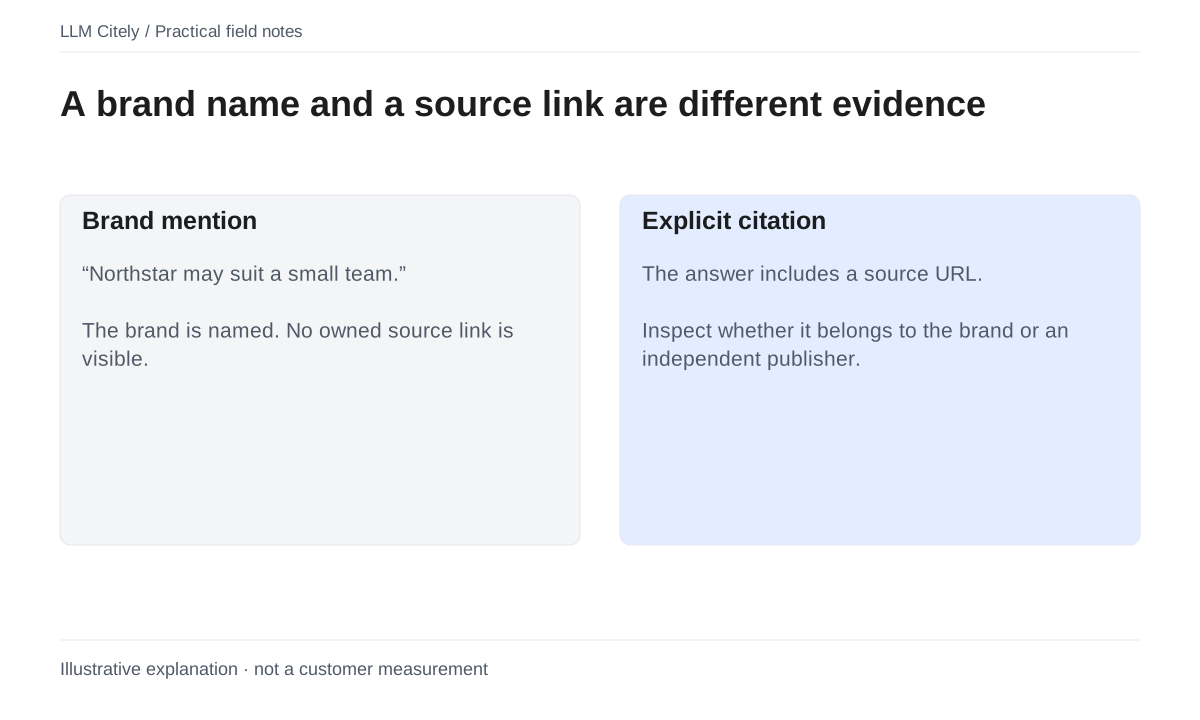
Start with the evidence you can point to
A reviewer should be able to identify the evidence for each label:
| Label | Evidence |
|---|---|
| Target mention | Approved brand identity appears in the readable answer text |
| Explicit citation | The answer visibly references a particular URL |
| Owned citation | That explicit URL belongs to an approved owned domain |
| Retrieved source | A relevant page returned during search, without an established explicit reference |
In this guide, textual mentions and link ownership are separate fields. A brand alias identifies a business; an owned-domain list identifies which cited pages belong to it.
OpenAI’s source guidance says a Sources view may contain both cited pages and other relevant links. Its entire contents should therefore not be counted as owned citations.
Use four examples to test your labels
These are constructed examples for the fictional Northstar brand and reserved .example domains.
| Example from the worksheet | Target-name mention? | Owned citation? |
|---|---|---|
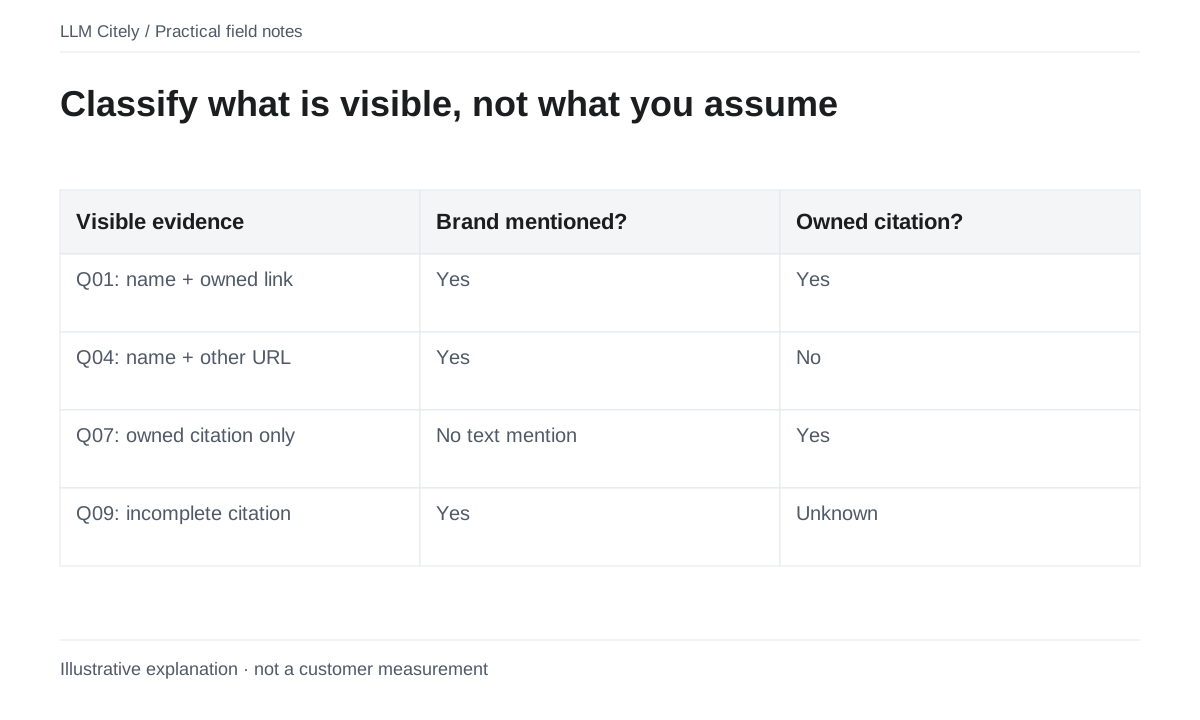
| Q01 names Northstar and explicitly cites northstar.example | Yes | Yes |
| Q04 names Northstar but explicitly cites review.example | Yes | No |
| Q07 says “follow this setup guide” and explicitly cites northstar.example, without the name in its text | No | Yes |
| Q03 names Example B and explicitly cites example-b.example | No | No |
The last row describes the target’s outcome, not whether any brand or citation appeared. Example B can be visible while Northstar has neither observation.
If source extraction is incomplete, an owned-citation cell must be unknown rather than “No.”
Classify a source-panel link without upgrading it
Here is the fictional Q04 answer:
Northstar and Example C are options to compare for signup analysis. Review the retention criteria in this comparison [1].
Reference [1] links to review.example/analytics-criteria. A separate Sources panel contains northstar.example/docs among other relevant pages.
The answer gives Northstar one textual mention. Its explicit citation is third-party-owned. The extra owned URL is a retrieved source, so it contributes no owned citation to the complete citation list in this example.
That distinction determines the follow-up: inspect why the third-party page supports the statement, and whether a useful owned explanation exists. Do not report that the owned page was cited merely because it was visible in the source panel. Investigate the source gap.
Let readable text and citation completeness be separate
Our shared illustrative worksheet contains twelve planned runs:
| Eligible population | Count | What it supports |
|---|---|---|
| Planned runs | 12 | Collection coverage |
| Valid answers with readable text | 10 | Mention rate |
| Answers with complete citation evidence | 8 | Owned citation rate |
Northstar appears in six valid answers: 6/10 = 60%. Three citation-eligible answers explicitly cite an owned URL: 3/8 = 37.5%. Collection coverage is 10/12 = 83.3%.
Q09 mentions Northstar but its source list is incomplete. It can contribute to the first rate while remaining excluded from the citation rate. Q05 and Q08 have complete lists with no owned citations, so they are legitimate citation negatives. An empty verified list and an unextracted list are different states.
Check which event a dashboard is actually counting
Before comparing tools or exports, ask what one row represents:
| Unit | Suitable question |
|---|---|
| Answer mentioning the target | Did the business appear in the answer text? |
| Answer with an owned citation | Did this answer explicitly cite an approved owned URL? |
| Individual source link | Which exact page was referenced? |
| Website visit | Did a person arrive at the site? |
One answer can cite several URLs. A citation can exist without a visit. Six target appearances among Northstar/Example B/Example C’s twelve appearances give 50% sampled SOV, which is another calculation rather than a replacement for the 60% mention rate.
The SOV walkthrough explains the counting unit. Traffic and conversions need their own analytics evidence.
Choose the next action from the evidence type
A wrong product fact in the answer calls for factual review. A complete citation list with no suitable owned URL can justify investigating the relevant owned material. A cited third-party page needs a page-level review before a representation or outreach task is proposed.
An incomplete list needs evidence repair first. Its unknown state says nothing conclusive about whether the brand’s website was cited.
In citation tracking, the useful next step is the exact source and question behind a classification. The methodology explains which observations belong in the calculations.
Questions, answered.
Can a brand be mentioned without being cited?
Yes. Its name can appear in the answer while no owned URL is explicitly linked.
Can a website be cited without the company name appearing?
Yes. The answer can reference an owned page without naming the business in its text.
Do more citations mean more traffic?
A citation is a reference event. Visits and conversions need their own analytics evidence; they cannot be inferred from the citation count.
Sources and further reading
Examples marked illustrative are not customer measurements.