Choose the brands and the counting unit
For this guide, an appearance means one tracked brand is present in one valid answer. A brand can appear at most once per answer for this calculation.
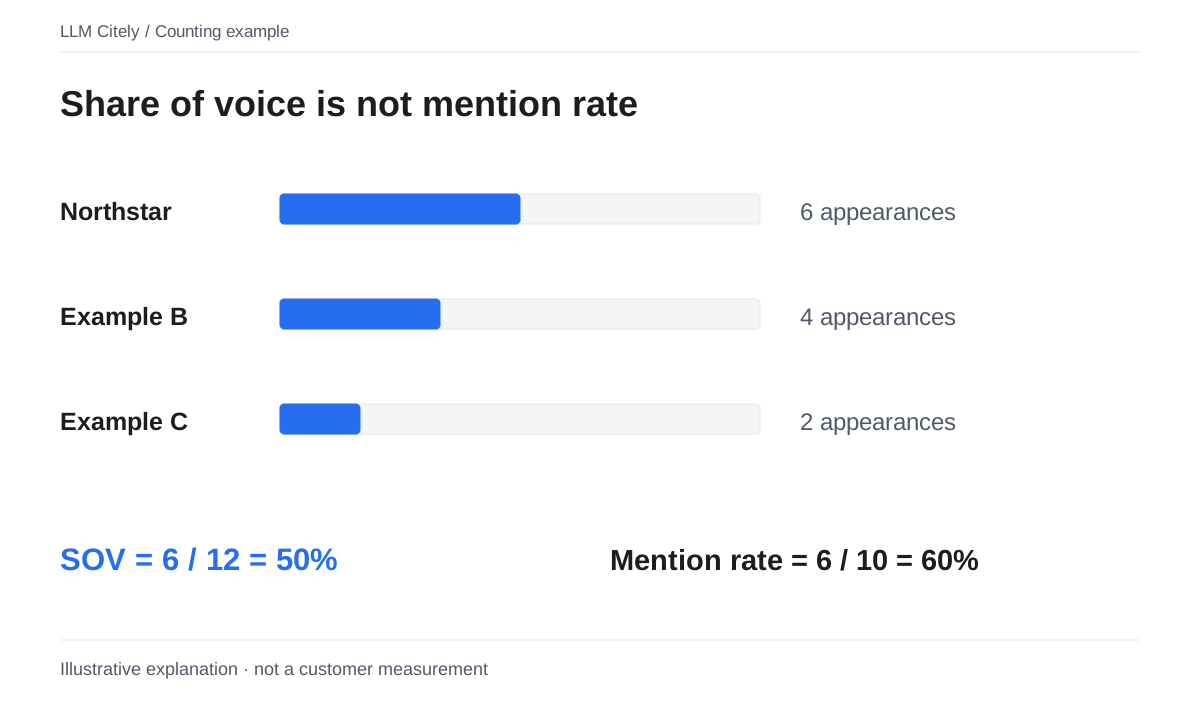
The comparison set is Northstar, Example B and Example C, all fictional. If an answer contains Northstar and Example B, it contributes two appearances to the set. An answer that names none of the three contributes zero appearances while remaining a valid answer for the mention-rate denominator.
Use the measurement worksheet if you need the complete twelve-row ledger.
Why the mention rate is 60% instead
Northstar appears in six of the ten valid answers:
Northstar mention rate = 6 / 10 = 60%
Northstar sampled SOV  = 6 / 12 appearances = 50%
Mention rate answers, “How often did our target appear in usable answers?” SOV answers, “What portion of this tracked set’s appearances belonged to our target?”
Q01 contains Northstar and Example B. It adds one valid answer to the mention denominator and two appearances to the SOV denominator. Counting the paragraph’s repeated names would create a different metric, so do not mix that method into this one.
Check the denominator when a share moves
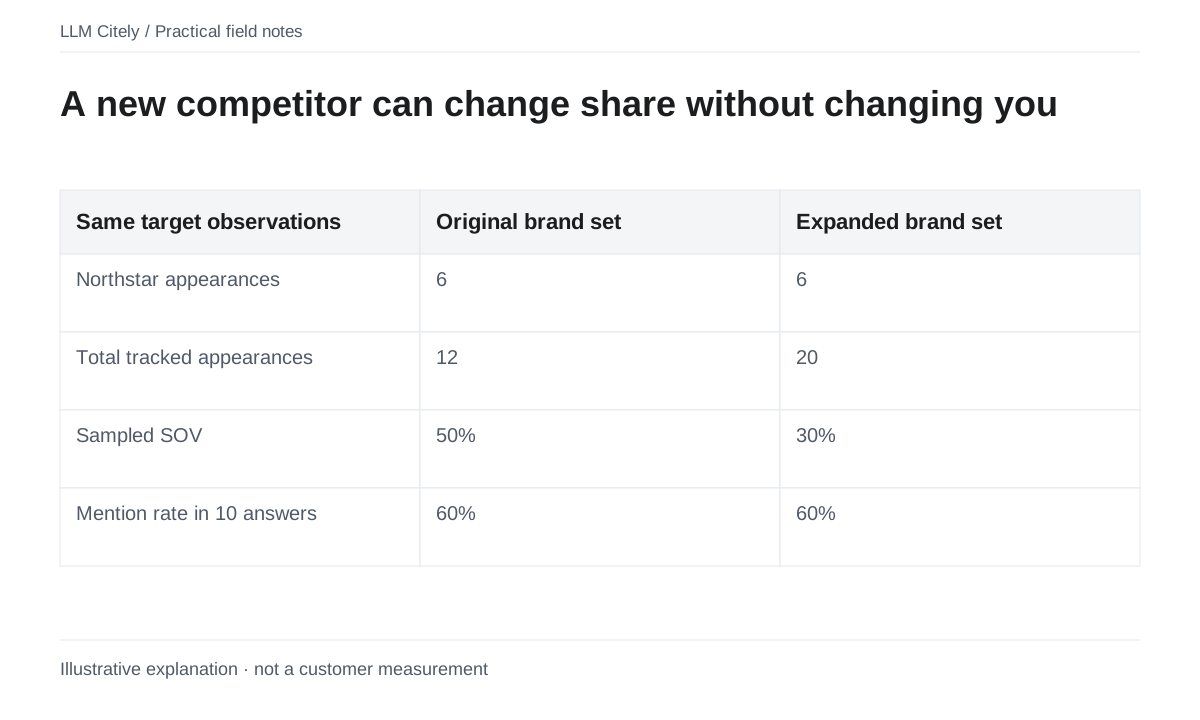
A change in relative share can come from the target, the competitors or the comparison design. Inspect the underlying counts before assigning work:
| What changed? | What to inspect |
|---|---|
| Target appearances | The particular questions gained or lost |
| Competitor appearances | Which competitors appeared, and in which answers |
| Tracked brands | Whether the comparison set expanded |
| Eligible answers | Failures, changed scope or excluded runs |
| Matching rule | New aliases or ambiguous company names |
The baseline has 12 planned runs, 10 valid answers and 12 appearances. Preserve those units in the report even when two totals happen to be equal.
Follow one changed question back to its answer
For the next review, start with the questions where a brand’s classification changed. Open the saved answer, confirm the identity match and inspect any explicit sources. Then decide whether the difference points to a factual error, a missing explanation or ordinary sample variation.
Use this report sentence for the constructed example: “Northstar accounted for 6 of 12 tracked-brand appearances, giving it 50% sampled share of voice; it appeared in 6 of 10 valid answers, a 60% mention rate. Collection coverage was 10 of 12 planned runs.”
Our counting methodology and answer-level workflow make the denominator inspectable. The calculation describes the selected sample and comparison set; revenue and market-wide demand require different evidence.
Questions, answered.
Why can share of voice fall while mentions stay the same?
Other tracked brands may appear more often, or the competitor set may have changed. Inspect both numerator and denominator.
Should every name occurrence count?
This guide uses at most one appearance per brand per eligible answer. Occurrence-count methods are different and must be labeled rather than mixed with this method.
Is sampled AI share of voice revenue share?
No. It is a relative presence measure within the specified answers and brand set. It does not estimate revenue, customer demand or the whole market.
Sources and further reading
Examples marked illustrative are not customer measurements.