Choose a small question set with a business reason
Use the same approved questions, observation surface and market for the brands you compare. Our fictional Northstar worksheet plans twelve analytics questions for small SaaS teams and yields ten valid answers.
Only eight answers have complete citation evidence. Three of those cite an approved owned URL, giving a 3/8 = 37.5% owned citation rate. Q09 and Q10 remain unknown for citation analysis; they are not two confirmed owned-page gaps.
The question-selection guide establishes the scope. Citation tracking provides the answer-to-source workflow.
Build the evidence trail for each candidate gap
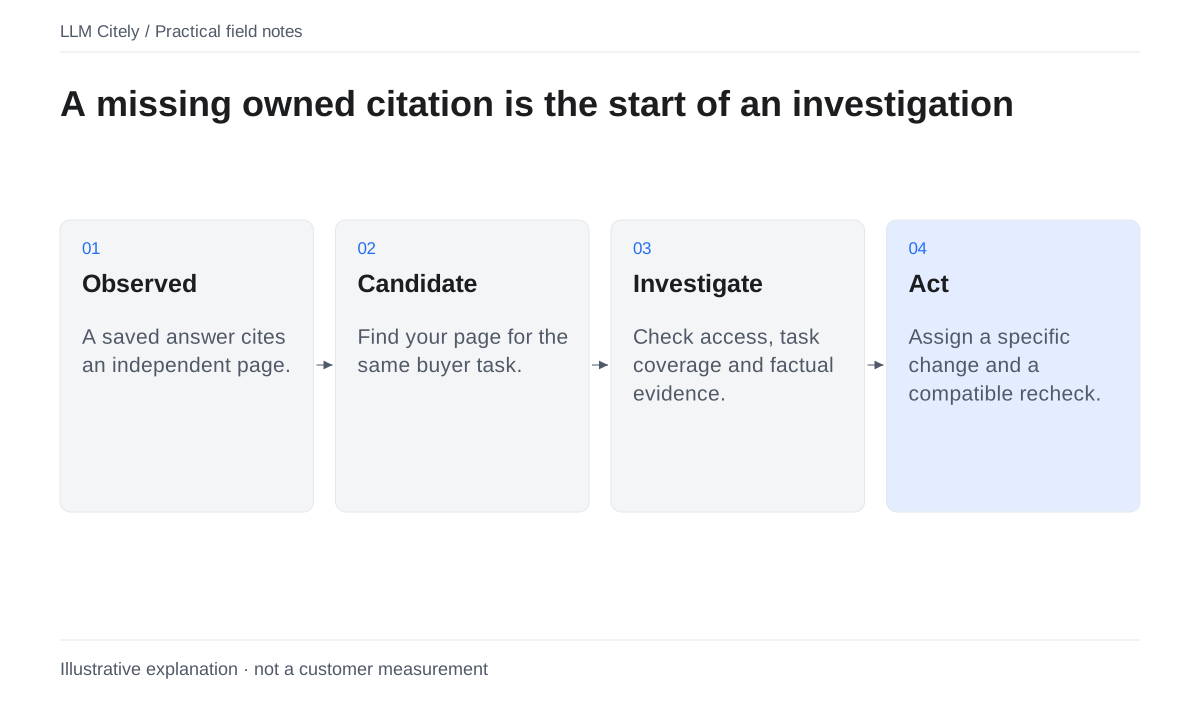
For a candidate such as Q03, the minimum useful artifact is a small chain:
Q03 wording and version
→ actual saved answer
→ its explicit citation
→ the exact cited page
→ the claim or passage that page supports
A domain appearing in a retrieved-source list is a lead to inspect, not an explicit citation by itself. OpenAI explains that its Sources view can contain cited sources and other relevant links.
Deduplicate the same URL for a summary while preserving the original reference. A page URL is more actionable than a domain count because the task concerns the particular explanation a buyer encountered.
Use a four-row investigation sheet
The following rows are constructed examples using reserved .example domains. No source pages were visited or ChatGPT answers collected for this worksheet.
| Run | Explicit source in the example | What is established | Next check |
|---|---|---|---|
| Q03 | example-b.example/docs/cohorts | Competitor-owned citation; target not named | What cohort question does this page answer? |
| Q04 | review.example/analytics-criteria | Third-party citation; target and Example C named in the answer | Does the cited page actually discuss either brand? |
| Q07 | northstar.example/help/setup | Owned citation without a target-name mention | Which setup explanation was useful? |
| Q09 | Citation list incomplete | Target named; source evidence unresolved | Complete the evidence before classifying a gap |
Q04 does not establish that the third-party page endorses Northstar. That conclusion needs the page’s own text. Q07 is a useful owned-source observation even though its answer text does not name the brand.
Name the gap before choosing the fix
Use three different classifications:
| Gap type | Evidence needed | Plausible follow-up |
|---|---|---|
| Owned-page gap | Complete citation list lacks a relevant owned page | Inspect whether a suitable owned explanation exists and is accessible |
| Content gap | The owned material lacks an accurate, useful answer | Produce or improve a supported explanation |
| Third-party representation gap | The cited page contains a verified omission or factual problem about the brand | Review that specific page and an appropriate response |
A competitor-owned citation is a comparison signal, not proof that copying its page would earn a citation. An incomplete list belongs in an evidence-repair queue rather than a content-production queue.
Use the mention/citation decision table when reviewers disagree about a row.
Write a task a reviewer can finish
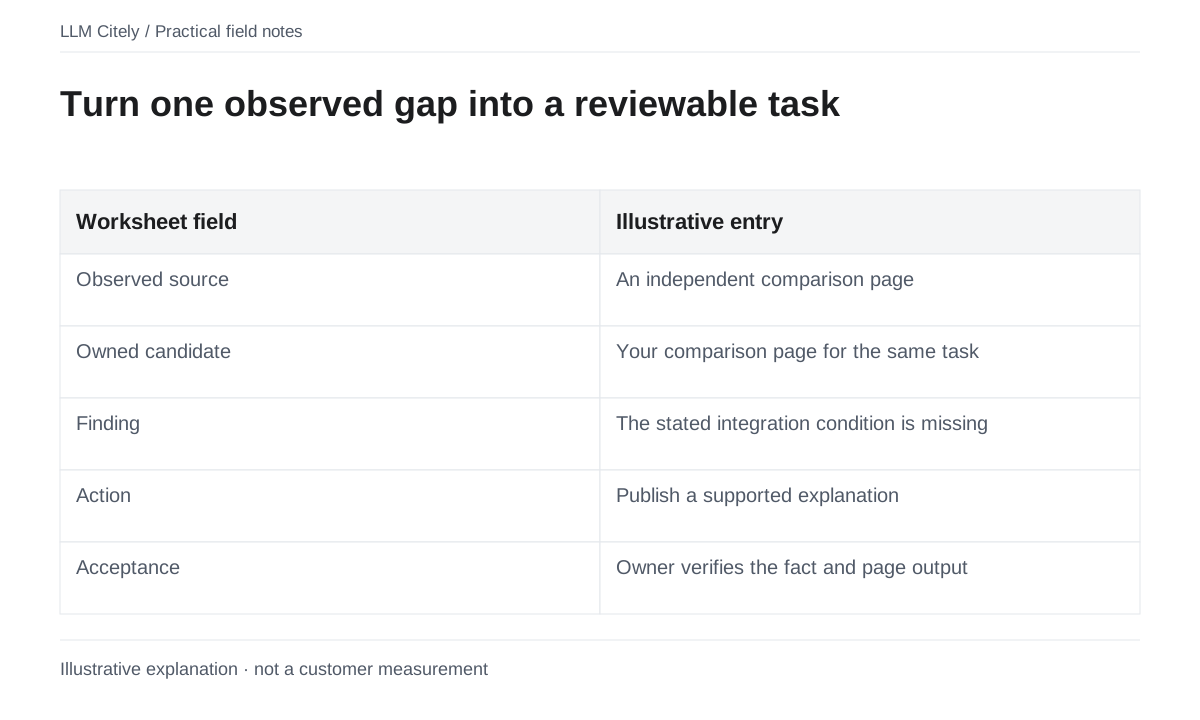
For the fictional Q03 investigation, this is a useful task:
Inspect the cited cohort guide and the client’s current cohort documentation. If the client supports the relevant workflow, draft the missing explanation with verified setup steps and limitations. Attach both page references for review.
The completion condition is the reviewed, factual explanation—not “win the citation.” If the client cannot substantiate the capability, reject the proposed content task.
For Q09, a different task is appropriate: recover or recollect its source evidence and classify it. Writing an article cannot repair an unknown citation list.
The optimization guide helps scope page work, and the report template connects it to client delivery.
Recheck the question and report the observed difference
After the approved work is completed, repeat the compatible question set and inspect the new answers. Show the original source, the completed task and the follow-up observation together.
If an owned URL appears later, describe that occurrence with its question, time and source evidence. Other factors may have changed too; the sequence alone does not prove the task caused the citation.
Use the same citation-eligibility rule in both periods. A higher extraction-completeness rate can change the measured citation rate even when brand mention counting was already complete. The measurement worksheet makes those populations explicit.
Questions, answered.
Is a competitor citation always a content opportunity?
No. Inspect what the cited page supports and whether the client can provide relevant, accurate information for the same task.
Can I find gaps using only cited domains?
Domains are useful for grouping, but an action needs the exact URL, question, answer and page context.
Does filling a gap guarantee a citation?
No. A completed task can improve the source material. The next observation shows whether the sampled answer changed, not a guaranteed effect.
Sources and further reading
Examples marked illustrative are not customer measurements.