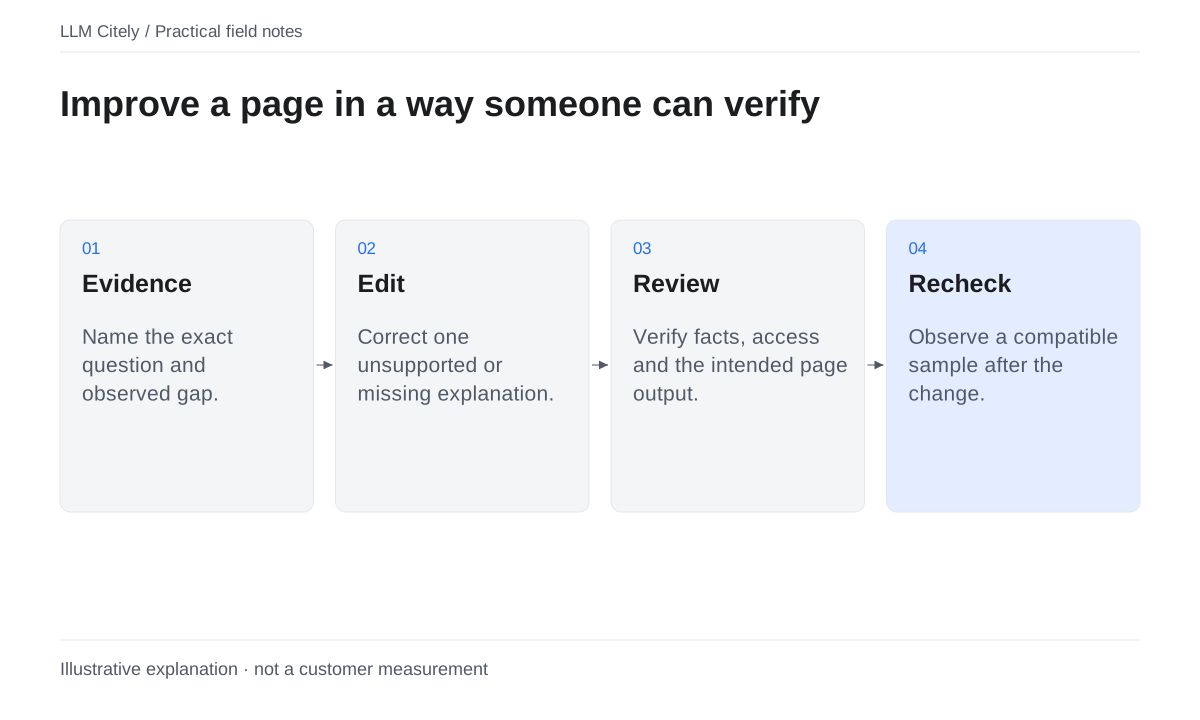
Find the question the page leaves unfinished
Choose one page and write the buyer's question beside it. For example, a reporting page may need to answer “What evidence will a client receive?” Read the page without using your background knowledge of the product. Underline the sentence that answers the question; if you cannot find one, that is the beginning of the task.
Do not start by adding every related keyword. Decide whether the existing page should own this question. A feature page can explain a capability, a guide can teach a process and a template can supply a reusable output. If another page already does the job well, link to it instead of creating a duplicate.
Use a scoped audit to separate a real content gap from missing access or collection evidence.
Assemble the facts before writing the answer
Create a small fact sheet with three columns: the claim, its source and who can verify it. For a report page, relevant claims might concern included fields, source links and the meaning of the saved period. Each real capability needs an appropriate product source.
A marketing phrase such as “complete evidence” is not a source. Ask what the phrase means in the output, then inspect that output or the relevant documentation. If the scope is undecided, resolve the question with its owner before publishing a precise claim.
For a third-party statement, open the original source and identify the supporting passage. A citation to a broad homepage is weak support for a narrow claim buried somewhere else. A citation-gap investigation should preserve that page-level context.
Rewrite one section so a buyer can use it
Here is an illustrative before-and-after treatment for a fictional reporting page.
Before: “Our platform turns insights into compelling reports so you can prove your impact.”
After: “Use the report summary to explain the questions reviewed, the answers available and the work completed. Include links back to the evidence for each finding. Show an unavailable observation as a gap rather than treating it as a result.”
The rewrite has a reader, a task and an output. A real product page would still need to explain which fields and links its current export actually contains. That is where the fact sheet controls the copy.
Now add the missing material a person needs: a labeled example report, a short explanation of the fields or an editable blank version. A useful addition changes what the reader can do; another paragraph of broad benefits does not.
Put the next useful task in reach
Once the section answers the question, link the reader to the next concrete action. A person checking report structure may need a report template. Someone deciding what to observe next may need buyer-question research.
Use an anchor that names the next task. “Copy the report worksheet” says more than “Learn more.” Place the link where the reader needs the material, rather than ending every section with an unrelated product pitch.
Check the return path too. A template should point back to the method that explains its fields; a tool result should point to the explanation needed to interpret it. This makes a small topic cluster useful even when its URLs live in different directories.
Review the finished page against the question
Hand the page to someone who did not write it. Ask them to answer the original buyer question and identify the evidence supporting the conditions. If they infer a capability the product does not have, the copy needs correction.
Then inspect the actual page version: title, heading, important text, links and relevant declarations. The public HTML example used in the audit walkthrough demonstrates why a declaration pass and a content judgment are separate. Its 72-word review flag does not specify how much text your page needs.
Google's people-first content guidance supports original effort and useful, accurate explanations. A fictitious expert profile or an invented result would weaken the page even if the layout looked polished.
Compare the completed work and the observation
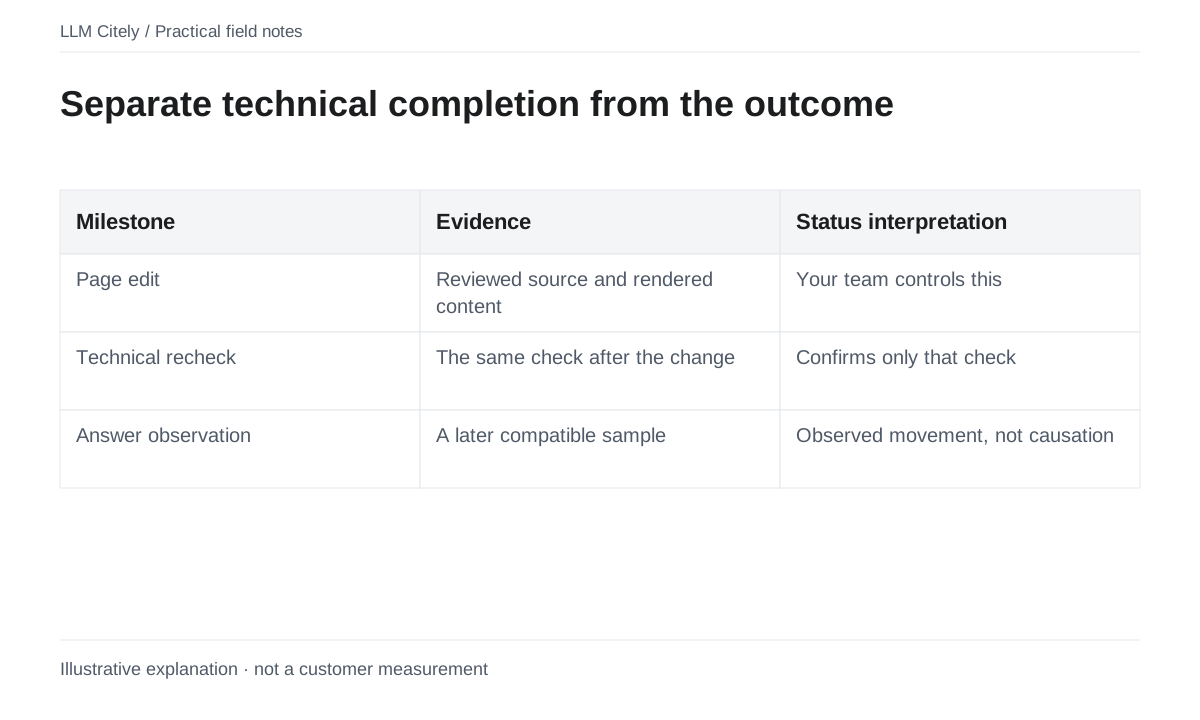
Publish the reviewed version with a change note describing what was corrected. Check the page task again after deployment. If your project includes answer monitoring, repeat a compatible question set and preserve the original wording and observation context.
Report the completed page work separately from the answer result. The edit may resolve the buyer's question even when a later sample is unchanged; a changed sample can also have causes outside the edit. Measure AI visibility using counts and scope a reader can inspect.
Choose the next page from useful feedback: a reader's unresolved question, a concrete source gap or a demonstrated access issue. The product workflow can connect that evidence to an owner, a task and the next review.
Questions, answered.
Is there a special AI schema or llms.txt requirement?
Google's AI-feature guidance does not require special AI markup or text files. Other systems may have their own documented uses, so evaluate a file against a specific purpose rather than promising a general ranking benefit.
Should AI search optimization replace existing content?
Update the page that owns the task when it is useful and accurate. Replace or merge content when evidence shows duplication, factual problems or a mismatched task.
How do I know a change improved visibility?
Compare a stable baseline and inspect the actual answers and sources. Report observed differences; additional evidence is needed to attribute them to one edit.
Sources and further reading
Examples marked illustrative are not customer measurements.