What the documentation can establish
This guide reviews documented question research, source inspection and editorial workflows as of 29 October 2026. LLM Citely, which operates in this category, is the publisher. We did not test whether any tool improves an answer engine's citation rate.
Compare the question-to-answer handoff
This is a public-documentation comparison, reviewed on 31 October 2026. LLM Citely publishes this page and offers a product in the category. We did not run comparative accuracy or performance tests.
| Product | Documented task | Ask to see before choosing |
|---|---|---|
| Semrush Prompt Research | A documented prompt research dataset | What is estimated, where does it come from and which market does it describe? |
| Ahrefs Brand Radar | Search-backed research and separately configured custom prompts | Does the task need discovery or repeated selected questions? |
| Profound content optimization | Briefing and editorial execution | Can a reviewer inspect facts, references and the publishing boundary? |
| LLM Citely content workbench | Evidence context, editable brief and versioned review | Check the actual editor and exports; CMS publication is not implied. |
Use the same prompt, surface, market, refresh schedule, missing-data case and export requirement for each provider. A documented capability does not establish its availability in every plan or account.
AEO starts with an answerable question
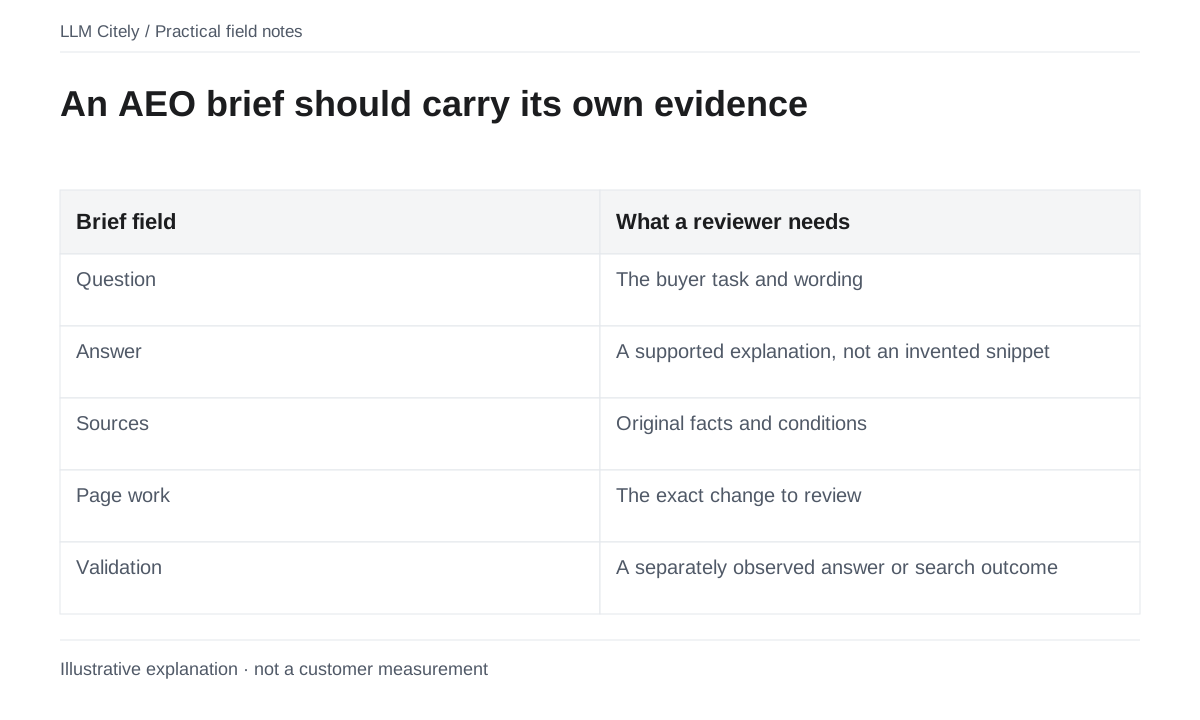
Choose a buyer question whose answer can be improved with specific facts. A comparison may need decision criteria and limitations; an implementation question may need steps and an example. The output should follow that task rather than a universal content template.
Before creating a new URL, inspect the current search and answer results. A definition, a tool and a selection guide may serve different intents even when the wording is similar.
Separate suggested questions from measured demand
Prompt suggestions help a team brainstorm coverage. They should remain reviewable hypotheses until supported by customer evidence or a clearly explained research source.
Ask providers to label their question sources and demand methodology. Do not compare an estimate from a topic database with Google keyword volume as though both measured the same activity.
Choose evidence for the answer brief
Question research: Semrush and Ahrefs
Semrush's data documentation explains its research sources and distinguishes topic-level estimates. Ahrefs Brand Radar describes a search-backed prompt index. Record the research source instead of labeling every question a measured customer need.
An inspectable export fact: OtterlyAI
Otterly documents citation CSV and raw-response exports. This can support a product fact in an answer brief; it does not establish demand for the question or predict a model's response.
Editorial execution: Profound
Profound Agents describes configurable content workflows and an approval step. Check the supporting facts and editable draft before considering publishing scale.
Make a selection you can revisit
- Write the buyer question, intended audience and the result the page should deliver.
- Determine whether you need new research, an answer/source inspection or a page check first.
- Ask how the tool distinguishes generated suggestions from measured or estimated demand.
- Review one draft and the source evidence before evaluating scale or publishing integrations.
- Define a follow-up question set before changing content.
- A question research library is useful for coverage, but niche customer questions may still require interviews and judgment.
- Generated drafts can accelerate preparation while introducing a larger review obligation.
- AEO and GEO overlap; their labels do not establish which specific tasks a product implements.
No fixed price comparison. Ask each vendor to quote the same prompt, platform, location, frequency, client and export requirements.
A small acceptance test before a commitment
- Save the buyer task, question set, requested surface and reporting period.
- Ask the vendor to show a source-backed successful result and a failed or incomplete one.
- Open the exact answer and cited page; keep the provider's metric definitions.
- Export the deliverable you plan to use, then read it as the client would.
- Price the same workload, including quotas, model-specific units and any reporting add-on.
Record an unavailable feature as unavailable; do not infer a comparison winner from a missing public detail. Keep actual LLM Citely platform status and shared points visible.
Turn the selected workflow into a real brief
Use the citation-gap walkthrough and editable content brief after selecting the workflow. These assets handle the editorial task; this page handles the software decision.
Questions, answered.
How are AEO tools different from GEO tools?
The labels overlap. This page focuses on question discovery and supported answers; the GEO comparison follows diagnosis, implementation and recheck across a broader delivery workflow.
Do I need a separate page for every question?
No. Questions sharing the same user task can belong to one main page. Split only when the intent and useful deliverable are different.
Can a content score guarantee inclusion in AI answers?
No. Ask what the score actually checks and keep it separate from evidence of a real answer or citation.
Sources and further reading
- Semrush AI Visibility Toolkit data sources
- Ahrefs Brand Radar overview
- SE Ranking AI Search in Competitive Research
- Peec understanding sources
- Profound Answer Engine Insights
- Profound Agents
- Otterly GEO Audit
- LLM Citely approved product scope
- Semrush Prompt Research official documentation
- Profound content optimization official documentation
This comparison uses public documentation and does not claim hands-on testing. Examples marked illustrative are not customer measurements.