Choose the result the reader needs
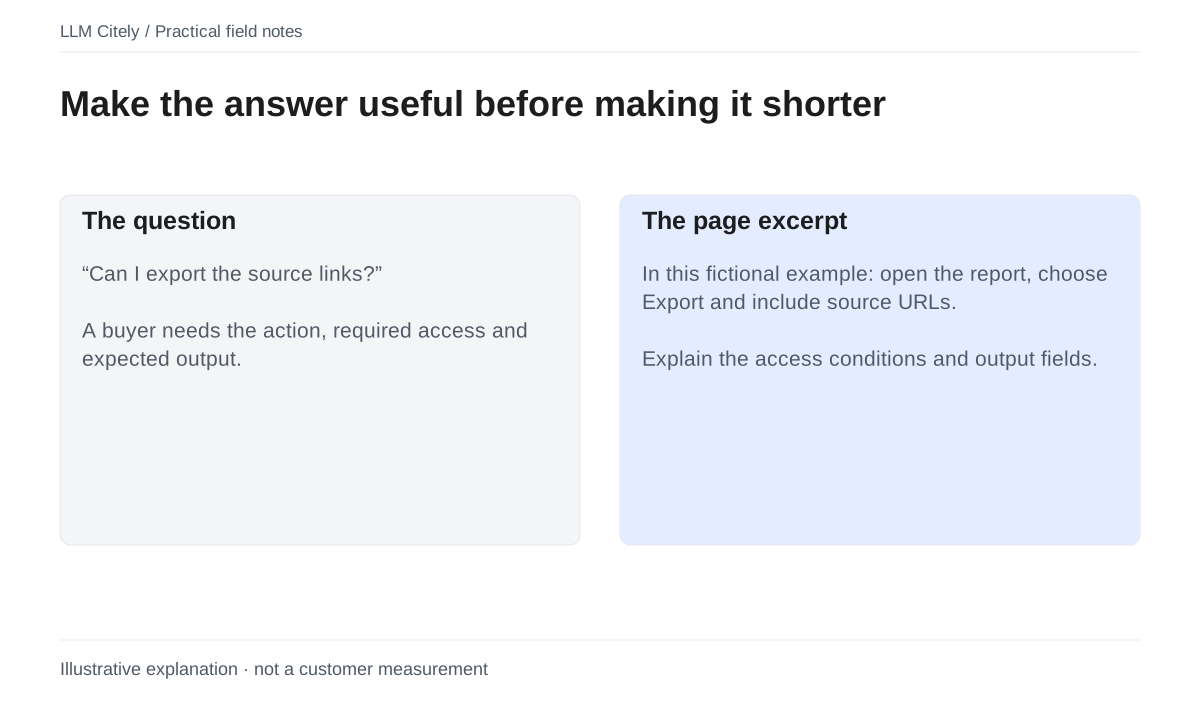
“Can I export a report?” looks like a yes-or-no question, but a useful answer usually needs more. A reader may need to know the available formats, whether source links are included, who can export and what happens to the data after the file is downloaded.
Write the question at the top of a review sheet. Under it, list what a person would have to know before they could act. These become the answer's conditions and instructions. If the question is “Which reporting product should I choose?”, the sheet should instead contain comparison criteria and trade-offs. That is a different page task.
AEO is an industry label for this answer-oriented work, not a promise that an engine will select a page. The practical acceptance test is whether the intended reader can finish the task using the explanation.
Replace a slogan with an answer
Here is an illustrative rewrite for a fictional reporting product.
Before: “Export powerful insights and share results effortlessly.”
After: “Open the reviewed report and choose an available download format. Before sending it, check the report period, included source links and the date of the saved snapshot. If an answer was missing from the period, leave that gap visible in the summary.”
The rewrite gives the reader an object to open, an action and a set of checks. It still needs the fictional product owner's factual review: the editor must confirm the real formats and whether the report is a snapshot. Good editing makes those facts explicit instead of filling them with confident guesses.
For your own page, mark every capability claim that needs a source. Ask the product owner to resolve it before turning the draft into instructions.
Give the answer a useful home
A capability question belongs with the capability. A longer process belongs in a guide. A reusable blank document belongs on a template page where it can actually be copied.
For example, a client-reporting feature page can explain the output and show an example. A report template can provide editable fields. A separate guide can explain how to interpret sample coverage. Linking those tasks is more useful than repeating the same paragraph on all three pages.
Use a descriptive heading for the question. Start the section with the answer, then add its conditions and the material needed to act. A FAQ can handle a remaining objection; it should not be the only place that explains the main workflow.
Keep the supporting fact near the claim
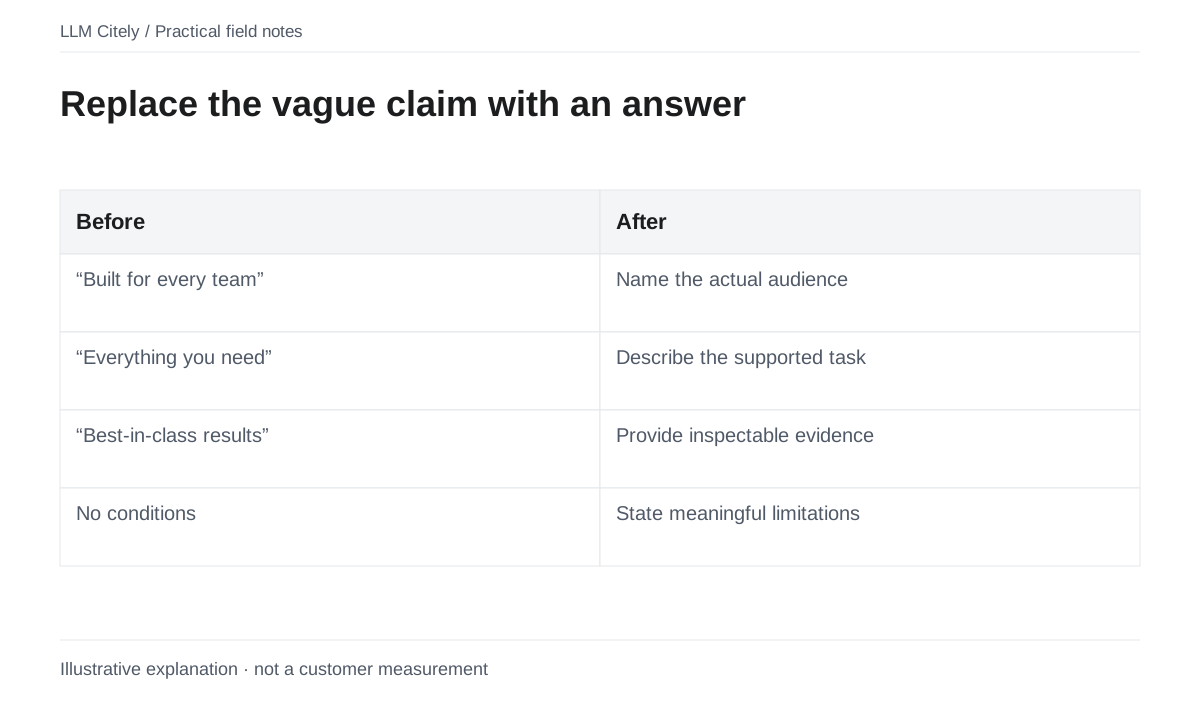
If a page says an export includes cited sources, show where those sources appear in an example export. If it explains a calculation, include the inputs and formula. If it relies on another organization's rule, link to the official description and state which experience that rule covers.
The reader should not have to leave a paragraph, search a document library and guess which passage supports it. Evidence is most useful at the point where a decision depends on it.
A quick editorial check is to highlight the factual claims in one color and their support in another. An unsupported capability, number or comparison remains an open question. An illustrative example is acceptable when labeled; it cannot take the place of evidence for a real product claim.
Check selection separately from answer quality
Once an accurate answer is published, observe how it appears in the target experience. A search snippet, a brand mention, an explicit citation and a visit to the page are different events.
Google states that publishers cannot designate a page as a featured snippet. Clear writing is worth doing because it completes the reader's task; selection still needs observation.
Use AEO vs SEO to distinguish answer editing from search foundations, and GEO vs AEO when defining a wider answer-monitoring project.
Questions, answered.
Is AEO just adding FAQs?
No. FAQs are one format. Many user tasks need a complete tutorial, an honest capability page, a usable tool or a substantive comparison.
Can a page be marked as the featured snippet?
Google states that publishers cannot designate a page as the featured snippet; its systems make that decision.
Does AEO require a separate website?
Usually the answer belongs in the same product website and its existing topic structure. Create a separate page only when it serves a distinct task.
Sources and further reading
Examples marked illustrative are not customer measurements.