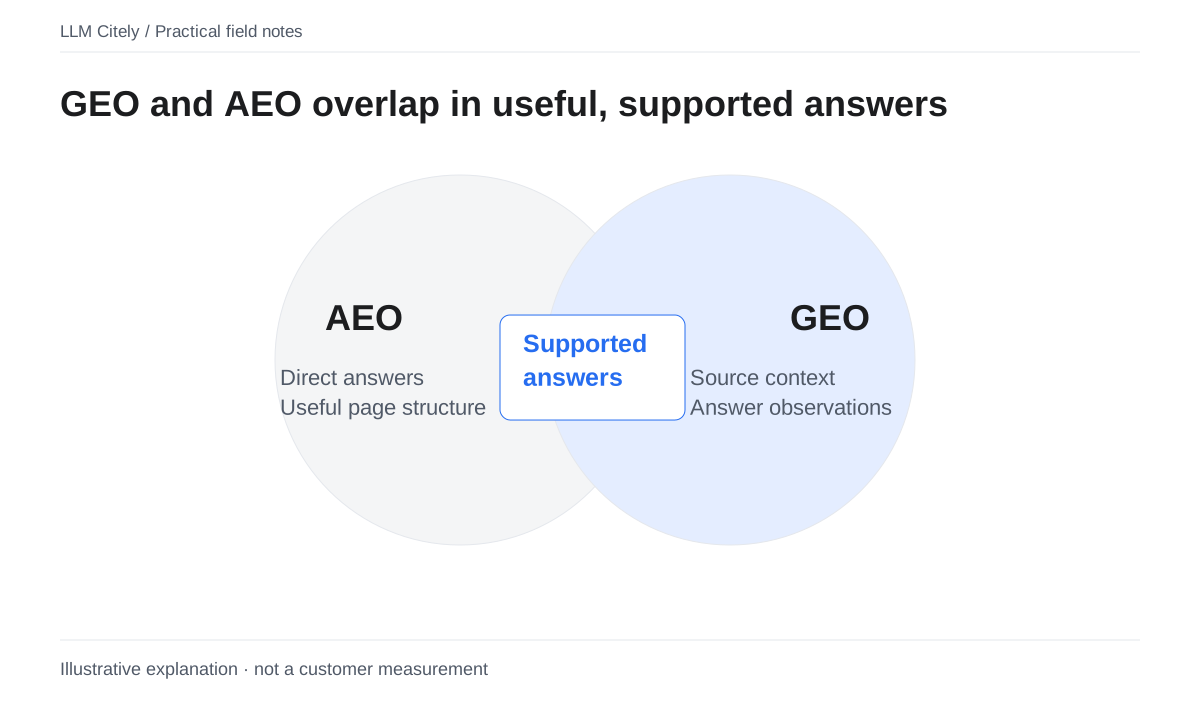
Two questions reveal the difference
Use these illustrative questions for a fictional reporting product:
- “Can this product export a report with source links?”
- “Which products should an agency consider for evidence-backed client reporting?”
The first asks for a reliable capability answer. The second asks for help choosing among options and may lead to a generated response containing brands and sources. The questions are related, but completing the first page does not establish what a platform will say in response to the second.
In this guide, AEO emphasizes making a specific answer usable. GEO describes the wider cycle of observing generated answers, examining source material and deciding what to improve. These are working definitions for planning; a vendor's acronym alone does not tell you its actual scope.
The answer task delivers a page a person can use
For the export question, start with the product owner's verified facts. Write the supported formats, where the user starts, what the file includes and what conditions apply. Add an example that makes the output understandable. The deliverable is a reviewed answer and the material needed to act on it.
A reviewer should be able to point to the sentence that answers the question and to the evidence supporting any important condition. If the draft says “all sources” but the export contains only one source type, the wording needs correction before publication.
The AEO guide uses a before-and-after rewrite to show this kind of editing.
The observation task delivers evidence for a decision
For the product-choice question, the team needs an approved question version, a defined market and an identified observation surface. The deliverable includes the original answer and its visible sources, followed by an interpretation that a reviewer can trace.
If the product does not appear, inspect whether the question represents a relevant buying task and whether collection succeeded. If a competitor page is cited, open it and find the part that supports the answer. The next action might be a factual correction, an owned-page improvement or further investigation; the acronym does not decide which.
The GEO introduction connects those steps into a small working cycle.
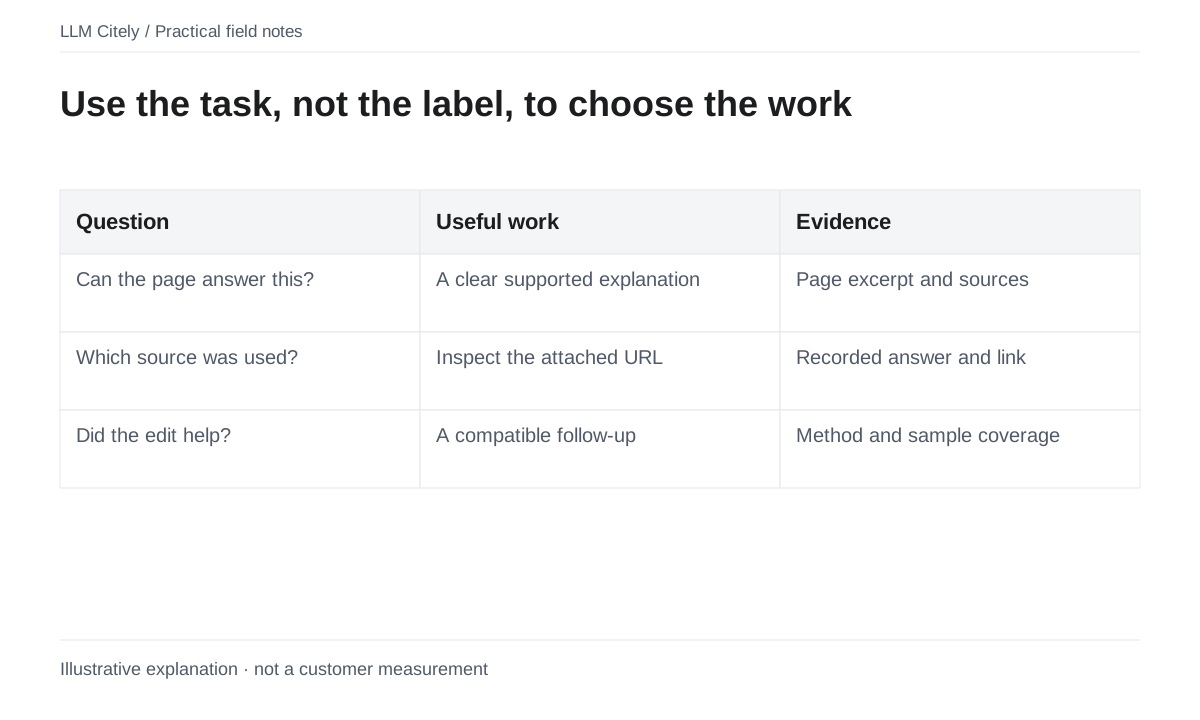
Put the scope in writing
Before accepting an “AEO package” or “GEO audit,” turn the description into a short agreement.
| Scope question | What an adequate answer contains |
|---|---|
| Which buyer task? | A specific question or reviewed question set |
| What will be delivered? | A page, tool output, source worksheet or answer evidence |
| Which experience is observed? | The named surface, market and collection method |
| Who confirms completion? | A reviewer and a visible acceptance condition |
| What will the report show? | Completed work, usable coverage and observations |
A scope such as “Make one export explanation accurate, document the sources, and review a compatible answer sample” is easier to evaluate than “Increase AI authority.” It also reveals where a page-editing assignment ends and a recurring monitoring assignment begins.
Combine the work without duplicating pages
One accurate capability page can support an answer-writing task and provide source material for an observation task. Keep the page in its existing product structure. Add a guide or a tool only when it delivers a different result.
For example, a capability page can explain report output, a template can provide a blank report, and a monitoring workflow can preserve original answers. Three useful tasks do not require three nearly identical “GEO report,” “AEO report” and “LLMO report” sales pages.
Compare the website foundations in GEO vs SEO, and use the measurement method to check exactly what an observation summary counts.
Questions, answered.
Are GEO and AEO exactly the same?
They overlap substantially, and different vendors use them differently. Ask what task, output, observation surface and reporting are included.
Does either term imply a special Google requirement?
No. Google describes its AI features in terms of existing Search eligibility and best practices, rather than a separate AEO or GEO certification.
Do I need two sets of content?
Usually not. One substantive page should own one user task; related answer, measurement and commercial tasks can link to it.
Sources and further reading
Examples marked illustrative are not customer measurements.