Follow the buyer, not the acronym
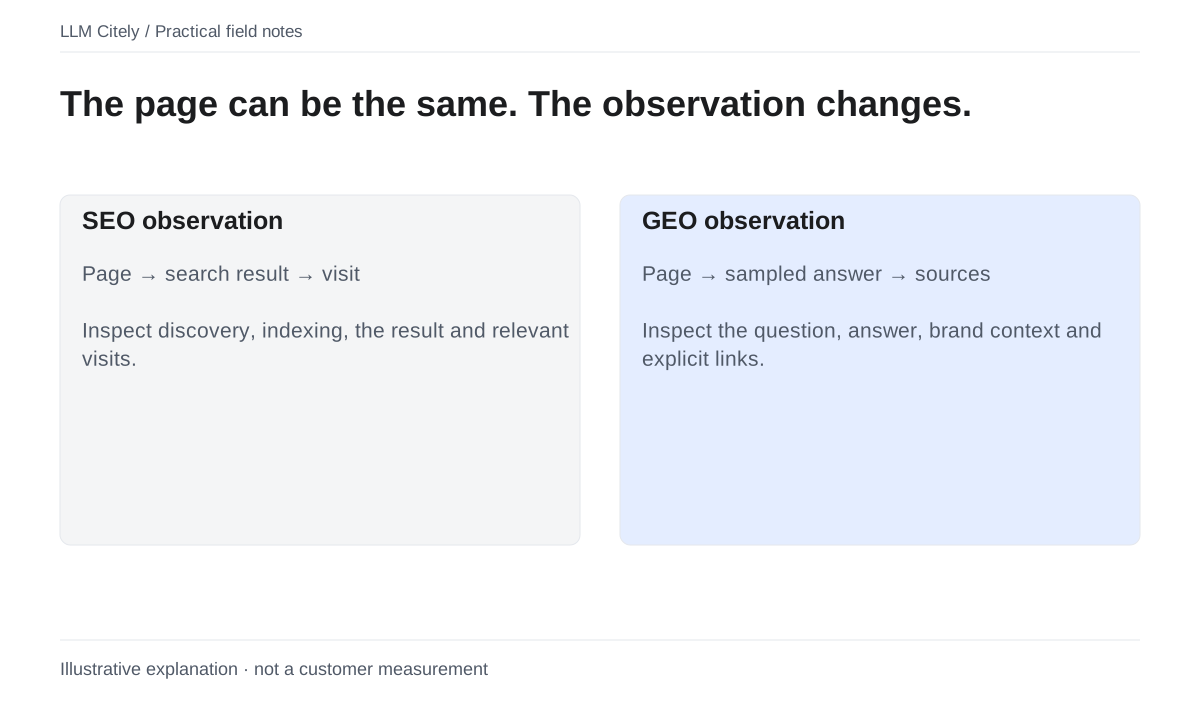
Consider an illustrative buyer researching reporting software. In one journey, they search, compare result titles and visit a product page. In another, they ask an AI assistant for options, read an answer and may follow one of its sources. Both journeys can lead to the same product explanation.
SEO work helps that page be discovered and understood through search. GEO work also asks how the business and its sources are represented in a generated answer. The difference is easiest to see in the evidence: a search-result observation concerns a result and a visit; an answer observation concerns a question, a response and its visible sources.
This is a planning distinction, not a claim that the experiences operate independently. Google's AI search guidance connects its AI features to the existing Search eligibility foundation.
Add the answer evidence
A GEO investigation begins after the question has been defined. Save the actual answer, observation surface, collection time and visible citations. Then classify what happened: the brand appeared, an owned page was cited, a third-party page supplied context, or the necessary observation was unavailable.
Opening the cited page matters. A competitor's name in the answer and a directory URL beside it do not, by themselves, show that the directory recommended that competitor. Inspect the passage before proposing a listing or content task.
This source-level review is an additional work item. It does not replace the website work that makes the destination useful. Define the GEO workflow when the team needs a shared scope.
Use separate scorecards
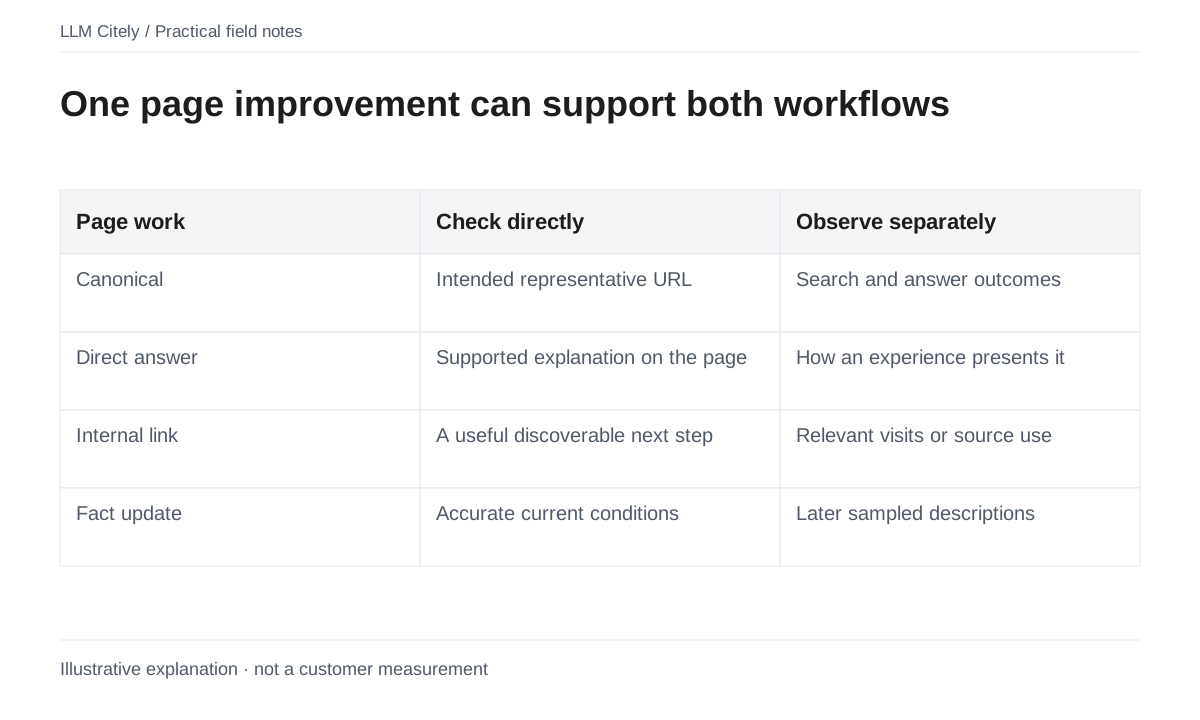
A page rank, a search click and a sampled brand mention are different units. Give them separate rows instead of blending them into a single “visibility growth” percentage.
An illustrative answer sample might contain ten eligible answers and six qualified brand mentions. Its mention rate is six out of ten. A search report for the same week might contain clicks to a landing page, but those clicks are a different population. Neither number can be used as the denominator for the other.
For every percentage, show the underlying count and the population it describes. For every comparison, preserve the query or prompt definition. The measurement guide provides the fields needed to explain an answer sample.
Choose the first fix from the evidence
Use the next action that resolves a demonstrated problem. A page-access failure needs technical investigation. An incomplete product explanation needs factual and editorial work. A question set containing only brand-named questions needs a sampling review before it can describe category discovery.
Do not choose a whole new program because a metric changed once. Look at the original page or answer, identify what is missing and define a completion test. This keeps a small team focused on work it can actually finish.
A scoped GEO audit is a useful way to assemble the page, answer and action evidence in one place.
Show the client the two trails
A useful handover contains a page-work trail and an observation trail. The first explains what was corrected and who checked it. The second shows which questions were sampled, how much usable evidence was returned and what the answers contained.
When the next sample changes, compare it with the baseline and the change log. A completed edit and an improved sample can happen together, but that timing alone does not isolate the edit's effect. Keeping the trails separate makes the work defensible without turning the report into a page of caveats.
If the client's real question is how answer-oriented writing relates to search, continue with AEO vs SEO.
Questions, answered.
Should a new business choose SEO or GEO first?
Start with the website and the buying tasks it must support. Then add a small answer-observation program when you can define and review the relevant questions.
Does a high search ranking guarantee an AI citation?
No. Search ranking and being cited in a specific generated answer are different observations. Inspect the actual answer and source link.
Should every SEO article get a GEO copy?
No. Improve one useful page for the task. Create another page only when its intent and deliverable are genuinely different.
Sources and further reading
Examples marked illustrative are not customer measurements.