Use a question the page must resolve
Take the question “What does an HTML readiness check actually test?” A person reaching the tool needs an answer before deciding whether its output is useful. A page full of “AI-ready” promises does not tell them whether the checker examines submitted markup, fetches a live URL or samples actual AI answers.
This makes a useful editorial exercise because it has a precise result: the reader should be able to name the input, the checks and the missing evidence. Start by writing that expected result in a review note. Then examine the page in two passes.
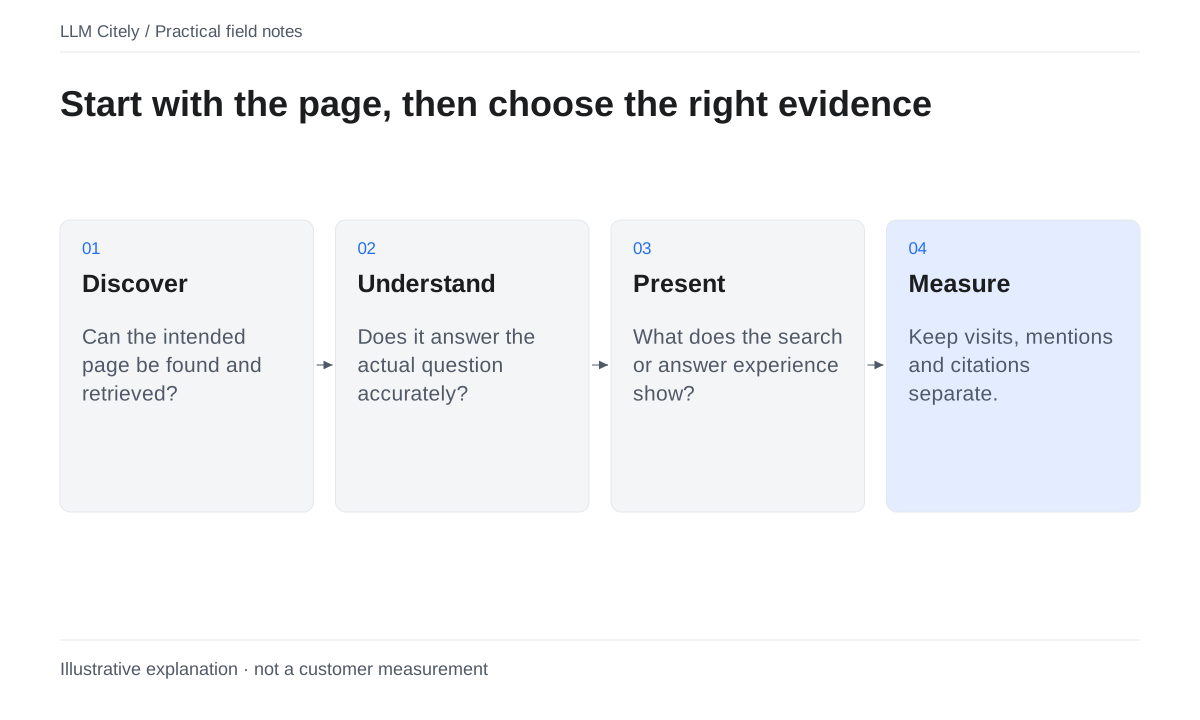
The distinction is practical. SEO work concerns how the page can be found and understood in search. AEO work focuses on whether the explanation resolves that specific question. The AEO introduction shows the general answer pattern.
First pass: can someone identify the right page?
Look at the title, main heading and the link that leads into the page. They should help a reader predict the task. A title such as “Resources” says little about an HTML checker; a precise title identifies the page's actual use.
Next, find the page through the site's navigation rather than by typing its address. Can a user move from the relevant guide to the tool? Is an unrelated page competing to explain exactly the same task? Resolve the page's role before adding another article.
This pass does not tell you how the page ranks. It produces an inspectable website result: a clear destination with a useful entry point and a description matching its function. Google's SEO Starter Guide is a reference for the broader search foundations.
Second pass: explain the input and the result
Now read only the introduction and the tool explanation. For an HTML-input checker, the essential distinction is that the user supplies markup. A check of that markup can report title, H1, canonical and JSON-LD syntax findings. It cannot establish a live HTTP response from the markup alone.
An illustrative answer for this task is:
This check examines the HTML you submit. Use it to inspect page declarations and structure, then verify live access separately; an HTML pass does not show that the address returned a successful response.
Put the explanation beside the input or result it describes. If the page also supports a live-fetch mode, give that mode its own explicit scope rather than letting the reader infer that every result includes network checks.
The audit walkthrough shows how this distinction changes the way a result should be read.
Make the proof visible instead of extending the slogan
A result table is useful only when its statuses explain what happened. A title check can show which declaration was found. A canonical check can show the URL it was compared with. An unperformed HTTP check should say that it was not checked.
This is answer editing as interface content: the explanation changes what a reader can conclude. Adding a long paragraph about the future of AI would not resolve the uncertainty.
The same pattern applies outside tools. A feature page should show what the output contains, a template should expose its editable fields, and a process guide should show the result of a step. Use the audit checklist to capture which evidence each claim requires.
Run two different checks before calling the page finished
For the first check, ask a reviewer to navigate to the correct page and explain what it does from its title and main heading. For the second, give them a result and ask what it establishes and what they would inspect next. A wrong answer reveals a specific gap in navigation or explanation.
Once published, search exposure and selection as an answer are separate observations. Google makes the selection for a featured snippet; a publisher cannot assign that role to the page.
A good edit therefore has a modest but concrete completion test: the intended page is discoverable within the site, and a reader can use its explanation correctly. Use the optimization workflow when you are ready to turn the findings into page changes.
Questions, answered.
Is AEO only for AI chatbots?
The term is used broadly for answer-oriented search experiences. Define the target experience rather than assuming every vendor means the same surface.
Will FAQ markup make a page the answer?
Markup does not let a publisher designate a featured snippet. Use accurate markup only when it describes the visible content and meets the applicable requirements.
Which comes first on an existing page?
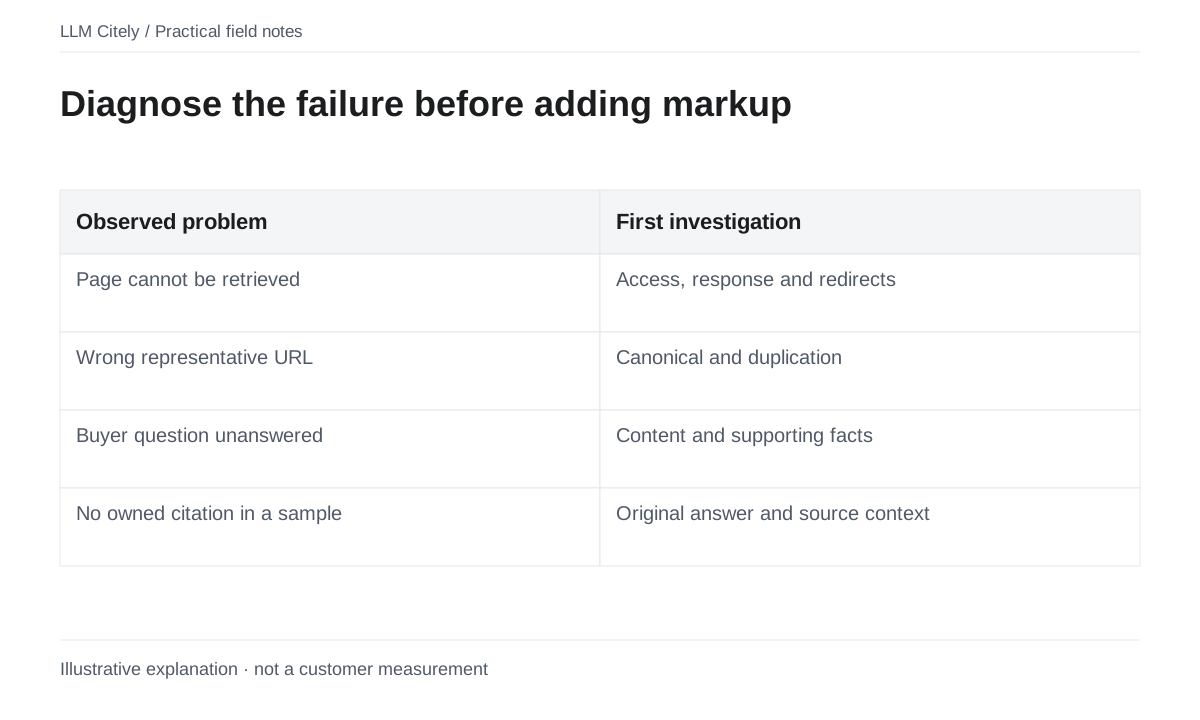
Fix the issue that prevents the task: access and discoverability if the page cannot be reached; factual and answer quality if readers cannot use it.
Sources and further reading
Examples marked illustrative are not customer measurements.