Read the run you already started
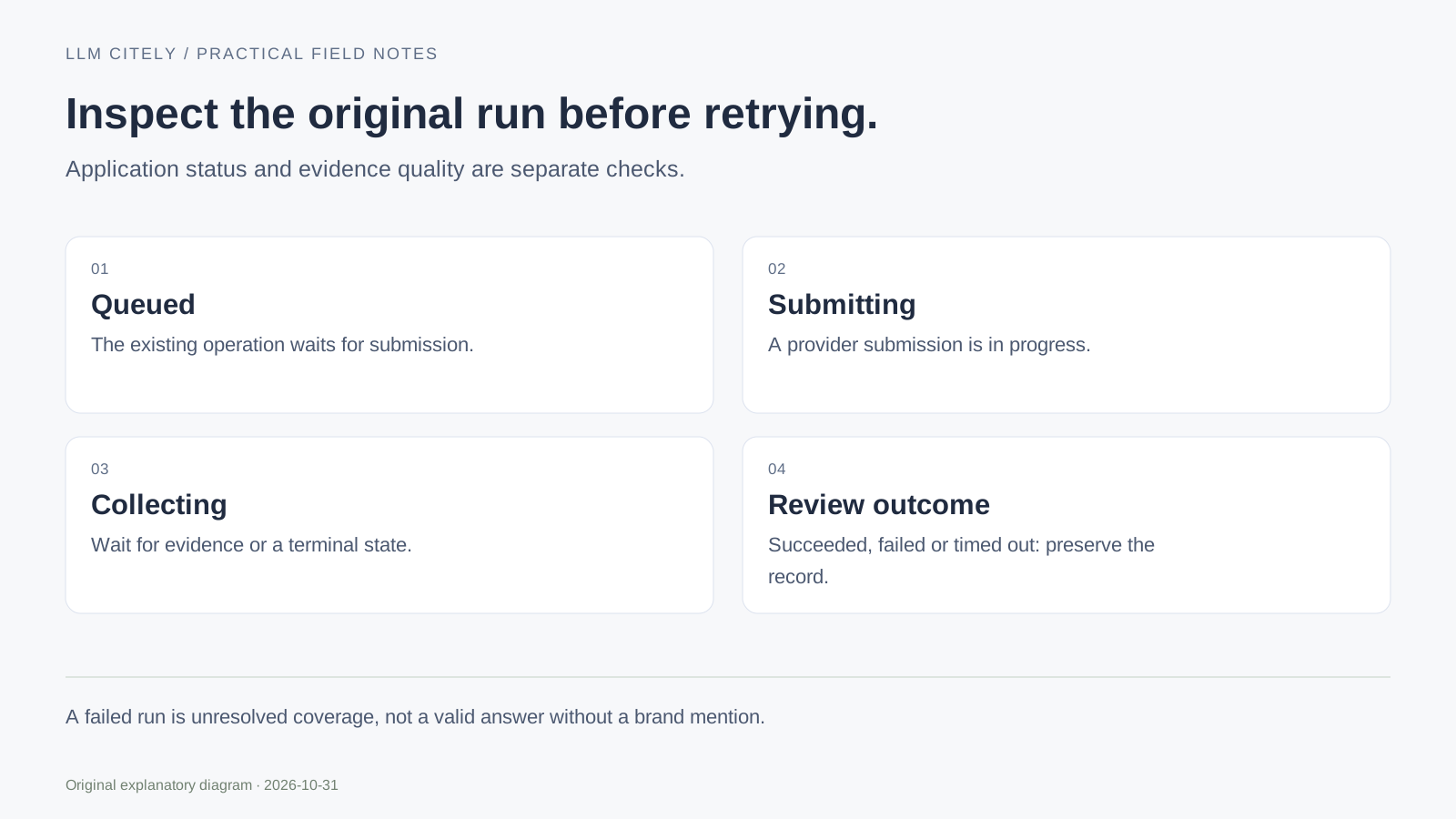
Find the original run and its latest status before starting another. A collection is an operation with a saved question context, observed surface and lifecycle; it is not just a button that immediately produces a score.
| Status | What it describes | Useful next check |
|---|---|---|
| queued | Work is waiting to be submitted | Current platform availability and allowance |
| submitting | A provider submission is in progress | Wait for the existing operation to settle |
| collecting | Provider work or result collection is in progress | Latest update and returned evidence |
| succeeded | A result was returned | Readability, surface and citation completeness |
| failed | The attempt ended without a usable successful collection | Recorded failure reason and usage settlement |
| timed_out | A submitted collection exceeded its allowed lifecycle | Original run, later evidence and settlement |
Provider-specific terms can differ from the saved application status. Preserve the recorded status rather than guessing from a vendor dashboard.
A returned answer can still have limited evidence
A succeeded collection is the start of review. Confirm whether the answer is readable and whether the expected surface and search context were established. Citation evidence can also be incomplete even when text is present.
This matters because a readable literal brand mention and a confirmed search-metric observation are different evidence. Do not fill an unavailable metric with zero or treat a missing link list as a confirmed absence of citations.
The comparison workflow shows how answer counts and stricter metric eligibility remain distinct. The measurement walkthrough defines the denominators.
Read the failure before choosing a response
Check whether the problem concerns configuration, provider availability, timeout or returned evidence. Repeated attempts cannot fix an unsupported surface or a missing quote. Review platform readiness before assuming another request will work.
Keep the run identifier, question version, surface and update time. If a provider failure is recorded, do not reinterpret it as a negative answer about the brand. If the original operation is still active, preserve it and avoid overlapping duplicate requests.
This public guide does not access private run details. The walkthrough image uses illustrative lifecycle states.
Keep points and result status side by side
Open the usage entry associated with the operation. A reservation, final deduction and returned points describe different stages. The supplier can also report its own expense; that internal liability is separate from the customer point balance.
Use points and usage to read these fields together. A retry is a deliberate new attempt with its own identifier and possibly a new quote. Do not assume that a failed provider response has already settled every related accounting entry.
If a result arrives late, preserve its provenance and the original run status. Avoid adding the same answer twice to a reporting cohort.
Keep the failed attempt in coverage
When a retry is appropriate, preserve the exact question, market, observation surface and brand rules. If any of these changes, label the new attempt accordingly. Connect it to the original investigation rather than rewriting the old outcome.
Illustrative report: 12 planned runs, 10 valid answers and two failed attempts have 83.3% coverage. If three valid answers mention the brand, the mention rate is 30%, not 25%. A later retry can change the coverage cohort; explain how it is counted.
Use the client report template to keep missing coverage visible, and the action plan for unresolved collection work.
Questions, answered.
Is a failed run an answer without a brand mention?
No. It belongs in unresolved coverage, not the valid-answer denominator.
Should I immediately rerun a collecting request?
First inspect the original operation. Overlapping attempts create separate work and make the evidence harder to interpret.
Sources and further reading
Examples marked illustrative are not customer measurements.