Keep the comparison population fixed
A useful comparison starts with the same buyer questions, period, market and observed surface. Save the approved brand names and aliases before reviewing the answers. An alias edit can change a count; a new question set can change the population.
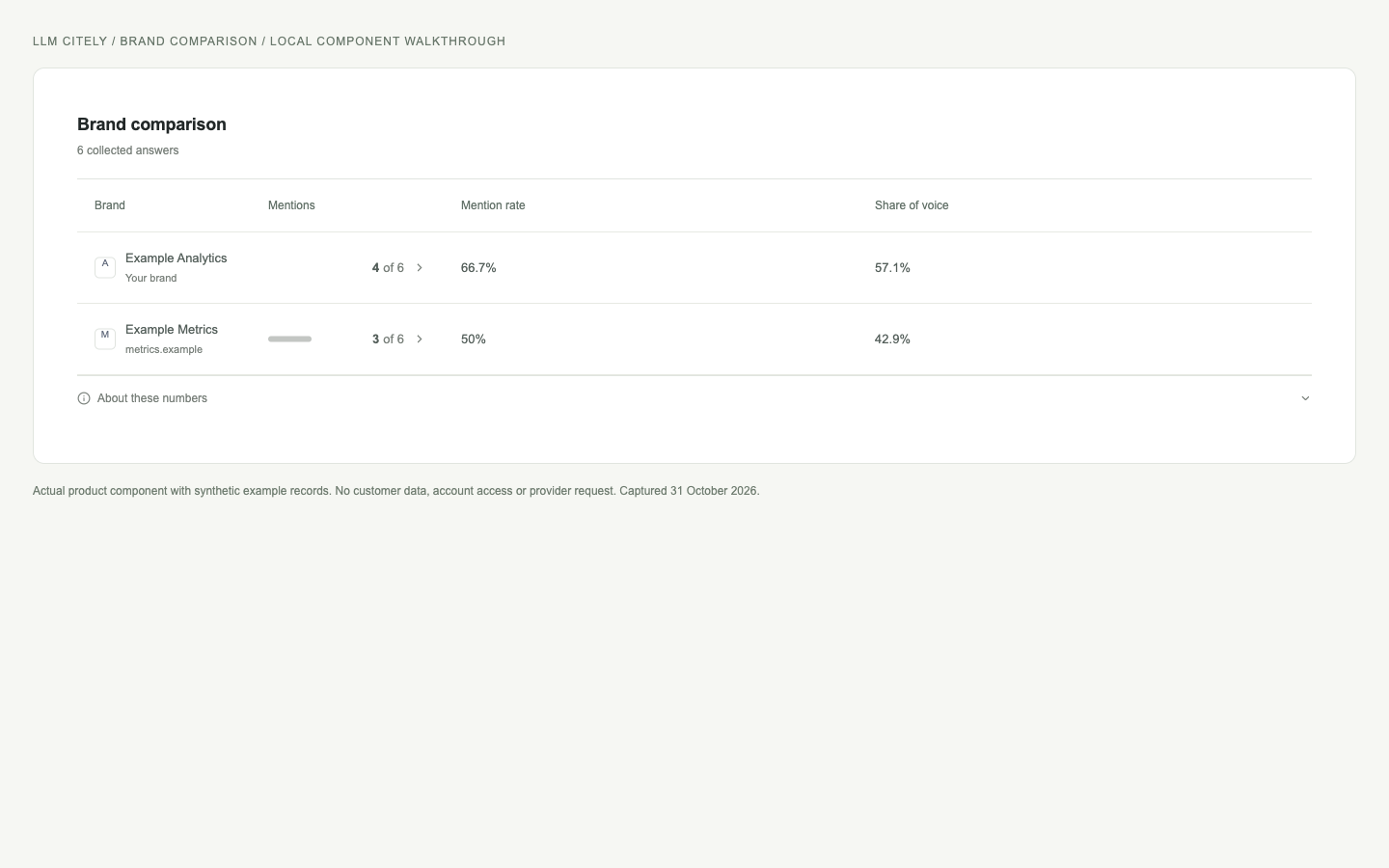
LLM Citely keeps a brand profile and comparison brands alongside the saved question context. The comparison view lets a reviewer open the answers behind a mention count. A literal mention is available for inspection even when search confirmation is missing; the stricter search metrics need eligible evidence.
Use the question-selection guide to keep branded evaluation questions separate from unbranded discovery questions.
Open the answers behind a number
Start with a brand's mention count, then inspect the relevant saved answers. Check whether the brand is recommended, mentioned in passing or named as a model provider. Those contexts can contain the same name and support different decisions.
Next inspect explicit source links. A competitor mention without a citation is different from a link to a competitor-owned page. The citation guide explains the counting distinction.
The comparison does not establish a permanent rank or a census of everyone using an assistant. The local component walkthrough below uses synthetic records to show the actual interface; it is not a measured result for a customer.
A small comparison you can recalculate
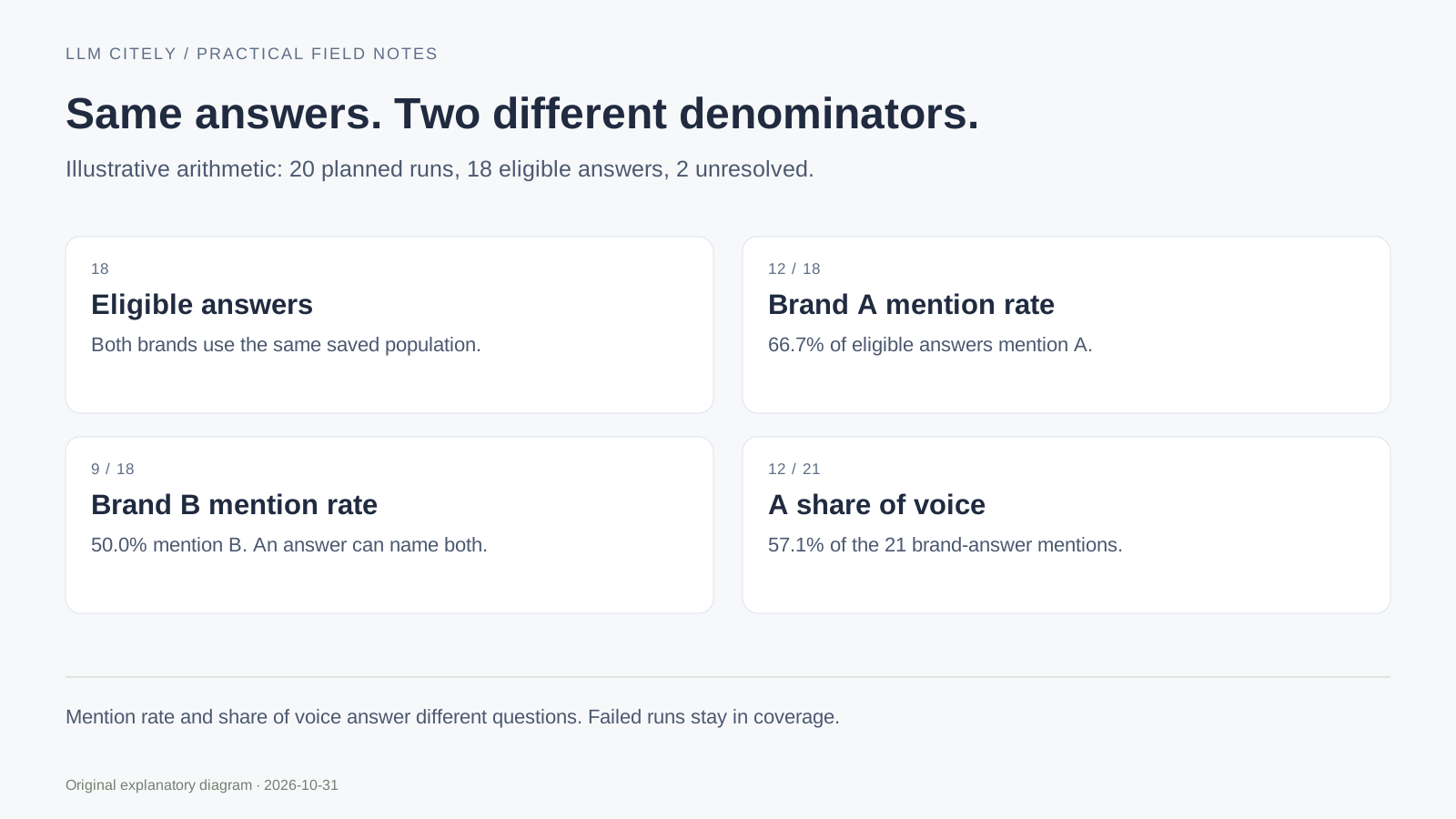
Consider an illustrative campaign with 20 planned runs and 18 valid, eligible answers from one unchanged cohort. Brand A appears in 12 answers and Brand B in 9. Some answers mention both.
| Measure | Brand A | Brand B |
|---|---|---|
| Answers mentioning the brand | 12 | 9 |
| Mention rate, using 18 eligible answers | 66.7% | 50.0% |
| Share of the 21 brand-answer mentions | 57.1% | 42.9% |
Mention rates need not sum to 100% because an answer can name several brands. Share of voice uses a different denominator. The two failed or missing runs belong in coverage, rather than being counted as answers that omit a brand. Citation rates also need their own complete-evidence denominator. Review the measurement method before comparing the values.
Give a source gap a specific next step
Choose one answer where the evidence supports a useful action. Save the question, collection context and cited URL. Open the cited page and verify what it actually says before suggesting a change.
If an existing page can answer the buyer question, improve that page. If the missing fact belongs in third-party documentation, assign a verification or communication task rather than writing a duplicate article. Attach an acceptance condition and reviewer in the GEO action plan.
The citation-gap walkthrough handles diagnosis. The content-brief walkthrough handles the editorial handoff.
Confirm evidence and availability
Platform readiness is published separately from the existence of this workflow. Review the current platform table before planning collection. A model API study and a consumer website answer are separate observation surfaces.
Keep a changed question set, alias rule or collection method in a newly labelled cohort. Missing, unreadable and failed answers stay visible. A before-and-after difference can motivate further investigation; it does not prove that a content change caused the difference.
For a buying decision, use the same question, market, surface, frequency and export requirements with each vendor. Promptmonitor's competitor page and Peec's source documentation are useful public descriptions of related workflows, not accuracy benchmarks.
Questions, answered.
Can every saved answer contribute to search metrics?
No. Readable mention evidence and confirmed search-metric eligibility are separate. Review the surface and eligibility before interpreting a rate.
Do two brand mention rates add up to 100%?
They need not. One answer can name several brands. Share of voice is a separately defined calculation.
Sources and further reading
Examples marked illustrative are not customer measurements.